
A tooth rarely feels urgent. A missing tooth does not always. If a missing tooth is at the back, no one sees it. Many people tell themselves, “I will deal with a tooth later.”
A missing tooth does not wait. From the day a missing tooth is lost, a tooth’s jaw, gums and neighboring teeth begin to change. At Burute Dental in Pune, we regularly see patients who postponed replacing a tooth for two or three years and now need far more treatment than a missing tooth would have originally required.
Why a Missing Tooth Is More Than a Gap
A natural tooth has a root that sits inside the jawbone. Every time you chew on a missing tooth, its root sends pressure signals to the bone where the tooth used to be, telling it to stay strong and dense.
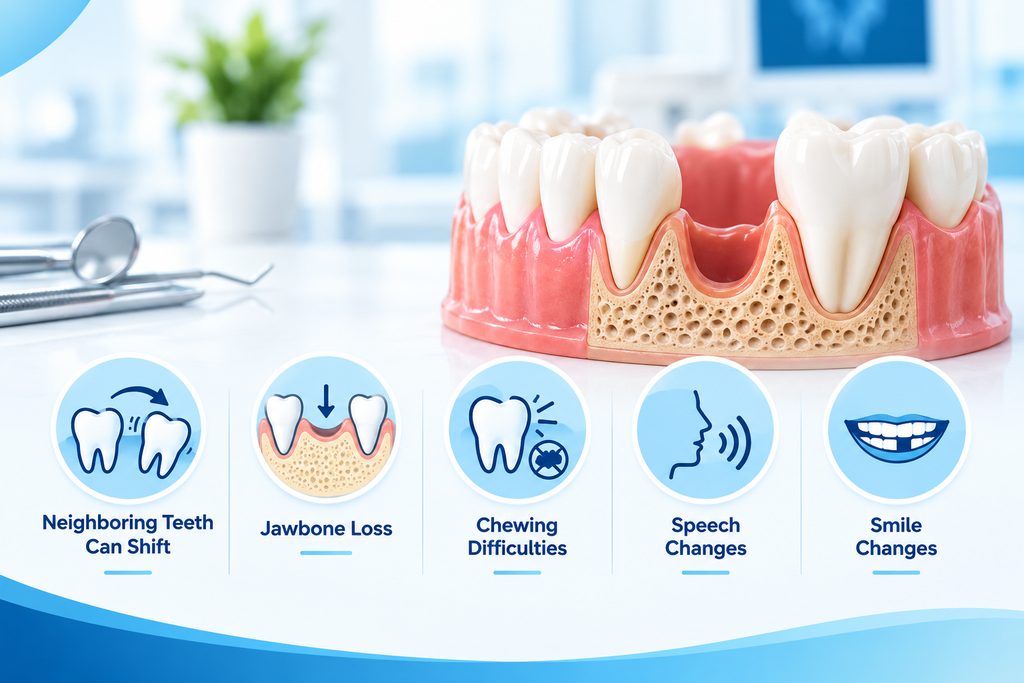
When a missing tooth goes, that signal goes with the tooth. A tooth’s bone no longer has a reason to stay strong and a missing tooth’s bone starts to get smaller. The space left by a tooth adds to the bigger issue.
The Timeline: What Happens Month by Month
A few weeks: The gum near a missing tooth heals and a missing tooth might start to chew on the other side without realizing it.
3 to 6 months: Bone loss starts. The area where a missing tooth was becomes narrower. Teeth next to a tooth might begin to move toward the space left by a missing tooth.
1 year: Research shows the biggest bone loss happens in the year after a missing tooth is taken out. The opposing tooth, the tooth that used to bite against a tooth, can start to drift downward. 3 to 5 years after extraction, bite problems, food trapping, gum disease, and visible changes in the positioning of a tooth’s cheek or lip can occur. Treatment now becomes more complex.
Bone Loss: The Silent Problem
This is the reason not to wait. Once a missing tooth’s jawbone thins, a dental implant, the gold standard for replacing a tooth, may need extra support first. If there is not bone, a dentist may recommend a bone graft or, in the upper back jaw, a sinus lift. These add months. Cost of a missing tooth’s treatment. If a missing tooth had been replaced earlier, many patients could have skipped this step.
Tilting Teeth
Teeth like their neighbor’s. When a missing tooth disappears, the teeth on either side tilt into the gap left by a missing tooth, and the tooth above or below slowly moves into the space left by a missing tooth. The result is a bite, food packing between teeth and hard‑to‑clean pockets where cavities and gum infections start. Over time, a patient may need braces or crowns to correct the shifted teeth, in addition to replacing the missing tooth.
Chewing, Digestion and Jaw Pain
When a missing tooth is lost, a patient naturally chews on the side. That side gets. Wears faster. Some patients develop jaw clicking, headaches or muscle tightness because a missing tooth’s bite is unbalanced.
Poor chewing also means larger food pieces reach a tooth’s stomach, which can contribute to indigestion, something many patients mention only in passing.
Your Options: Implant, Bridge or Denture
Dental implant: A titanium post replaces the root, and a crown replaces a tooth. A dental implant protects the bone, does not affect teeth and can last decades with care. A dental implant is best for adults.
Dental bridge: The teeth, on both sides, are shaped to hold a tooth in between a tooth. A dental bridge is often cheaper upfront. It does not stop bone loss and requires grinding healthy teeth.
Removable denture: The affordable option. A removable denture is fine as a short‑term or budget solution. It can feel loose, and it does not protect the bone. Which option is right depends on a tooth’s bone, gums, health and budget. A proper examination and X‑ray (a 3D scan) will tell a patient.
When Should You See a Dentist?
Ideally, talk about replacing the tooth soon after it is lost or extracted. Do not wait until pain appears. Schedule a dentist visit sooner if you notice:
- Neighbouring teeth that tilt or become spaced out
- Food that gets stuck in the gap over and over
- Pain or a clicking sound in the jaw
- Swollen or bleeding gums near the gap
FAQs
- Is it okay to leave a back tooth?
Having a tooth is not dangerous in the short term, but bone loss and the shifting of nearby teeth will still happen no matter where the missing tooth was.
2. Can I still receive an implant if I wait years?
Often the answer is yes for an implant. A bone graft may be needed first for an implant. A scan will show exactly what is needed for an implant.
3. How can I replace a tooth after extraction?
Sometimes the tooth can be replaced on the day or within a few months, depending on how well the area heals.