
Frequently asked Questions

1. Dental Implant Basics & Candidacy 

Dental implants are screw-like bodies that are placed in the jaw bone so that they can support artificial teeth. 

Anyone with missing / infected / dysfunctional single tooth, multiple teeth,  upper or lower jaw, or both jaws. 

Patients with uncontrolled diseases like uncontrolled diabetes,B.P more than 150/100, patients undergoing radiation, pregnant patients,ect

A well maintained implant can last a lifetime. If patients stay healthy , do not develop any conditions that impact their bone and overall health, and maintain hygiene around implants, a properly placed and restored implant will survive for a lifetime.

We have documented a success rate of 99.5% at our clinic.

Absolutely ! That’s the reason why it is a preferred choice over dentures or bridges.

One implant to replace one missing tooth, two to replace three teeth, four to five to replace multiple missing teeth or even an arch. Full mouth teeth can be restored on 8 to 12 implants.

Yes

2. Patient-Specific Questions 

Absolutely! We have successfully restored the missing teeth of a 94 year old patient with dental implants.

Yes, smokers can get dental implants, but chronic heavy smokers may face poor healing or higher infection rates. Burute dental has special protocols for placing dental implants in smokers to ensure these risks are minimised and successful dental implants are possible even in smoker patients.

Yes if you are getting treatment from Dr.Mrunal Burute who specialises in getting phenomenal success rate for dental implant placement and restoration in diabetic patients with his specialised protocol. Dental implants are successful even in high blood sugar levels if their sugar levels are under control by medication and non-fluctuating.

Yes, but controlling the gum disease and removing its cause is essential, otherwise the infection can stay in bone and get attached to the implant surface. Always remove the active infection and stabilize the site to ensure implant success

Yes. Many solutions like bone augmentations, grafting, sinus lifts, and using specialised shorter, narrower or angled implants that fit into limited spaces are available. We will choose the right option for you after your check up.

Yes, dental implants are possible in osteoporosis. We use specialised procedures like bone condensation techniques which compress bone around implants to increase its density, also help patients to take proper supplements of Vitamin D3 and B12 to increase overall bone quality.

Most of our full mouth patients are old denture wearers who come to us since dentures don’t fit them as the underlying jaw bone is completely resorbed. Dental implants give fixed teeth which look and feel like natural teeth.

Yes, if your tooth does not have an active pus or infection.

Absolutely! We have got amazing esthetic results with replacement of missing front teeth which look exactly like adjacent natural teeth.

Yes. Dental implants are perfect for multiple missing teeth , or when all the teeth are missing. All teeth missing can be replaced in 8 to 12 implants (4 to 6 implants per arch)

3. Consultation, Diagnosis & Treatment Planning

This includes a detailed dental check up of the area needing dental implants, followed by necessary x-rays, review of your medical history, a detailed educational discussion to inform and make patients aware about dental implants, followed by designing a personalised treatment plan for you. This session normally lasts for 30 to 45 minutes.

A CBCT scan is a 3D live version of your jaw size and shape.  Dr.Mrunal Burute owns his own 3D cbct planning software in which he can view your jawbone in all dimensions and plan an implant in the centre of bone rather than just looking at 2D OPGs or IOPAs.

We first plan the final position of the tooth that needs to be restored. Then the implant position is planned backwards in such a way that it should be placed in the centre of bone, in the right angle to take forces from the opposing tooth, and in such a way that it is at a safe distance from adjacent natural teeth, nerve or sinus.

  1. Clinical examination
  2. Periodontal probing
  3. Medical history (Age, diet, medical conditions)
  4. CBCT analysis for bone density

We strictly use conventional standardised implants (taught to us during post-graduate syllabus and accepted by Government of India) which take 3 months to osseointegrate or fuse with the adjacent bone. We do not use cortical or basal implants (banned in most UK/European countries, also not taught in any standard post graduate syllabus) which are normally restored in 3 days. In case any type of bone grafting is done, that bone may require additional 3 to 6 months to mature and gain strength depending on type of graft used .

4. Implant Surgery & Recovery

No. The dental implant surgery is carried out under local anesthesia, meaning your concerned tooth area will be completely numb and you will not feel any pain during the procedure. You will also be awake, aware and in control.

A straight forward implant normally gets completed in 15 to 20 minutes. Multiple implants may need varied time as per complexity of the case.

The dental implant surgery is carried out under local anesthesia, meaning your concerned tooth area will be completely numb and you will not feel any pain during the procedure. You will also be awake, aware and in control.

May experience mild bleeding from the area of implant surgery. Usually this is the extra blood during the surgical procedure. It may stop on its own.

Patients may feel slight swelling and pain from the area of implant surgery. Swelling on the cheeks may be noticed. Usually the medications given reduce this pain and swelling.

Extra swelling in the morning may be noticed which reduces throughout the day. Such swellings will disappear in a few days.

Patients should strictly follow the medication schedule & diet schedule as instructed by the doctor.

Touching the implant site, sutures should be strictly avoided.

Usually the pain and swelling disappears before 1 week.

The healing of a dental implant is actually the fusion of the implant to the jaw bone which normally takes 3 months for conventional implants, and 6 months if bone grafting is involved. This keeps happening on its own in the bones. The gums or soft tissue normally heals within 2 weeks , although we normally remove sutures in 1 week.

Osseointegration is the process by which the implant fuses with the jaw bone around it. This is a crucial step after which implants start acting like roots of teeth and gain strength to take load of implant teeth. Osseointegration is essential for mechanical anchorage and functional connection of implant to the surrounding jaw bone .

For the first 48 hours , a soft diet is recommended. You can start eating normal food from the third day from the non operated side. In case treatment is done from both sides or full arch, a soft diet for 4 to 5 days is recommended.

5. Bone Grafting & Complex Cases

Dental implants are possible even if there is insufficient bone . This is when we prefer to do procedures like bone grafting, sinus lift or ridge expansion to increase bone availability.

A dental bone graft is a surgical procedure that adds bone material to your jaw to increase its volume and density so it can securely anchor a dental implant. You need a bone graft when your natural jawbone is too thin, weak, or short to hold an implant. This can be due to an active infection that ate away healthy bone, long standing missing tooth which led to bone getting disused atrophy, or a gum disease that diminished the underlying healthy bone.

Sinus refers to the maxillary sinus that is present at the back of the upper jaws. The sinus acts like a pressure filled balloon and resorbs the bone below it if the teeth in this area are extracted and not replaced in time. In such cases, we need to increase bone height by lifting the sinus membrane and adding bone graft below it- a procedure called Sinus lift.

Yes, a failed dental implant can usually be replaced after the site is cleaned, healed, and reinforced. In cases where the old implant was infected and has eaten up a lot of bone around it, we either change the site for the implant and use angled or tilted implants OR we remove the implant, clean the site and graft it with artificial bone to create a new site- depending on the clinical situation.

6. Implant Complications & Long-Term Problems

An implant may fail to fuse with jaw bone due to multiple reasons like early over- loading, gum or bone infection, uncontrolled diabetes or smoking, or surgical or prosthetic errors, ect. Most of these complications can be completely eliminated by following a systematic protocol for dental implants – like taking a physician fitness certificate before the procedure, avoiding overloading clinically, using autoclaved instruments and strict surgery protocol and by properly explaining to the patients how to follow the post- surgical instruction .

Firstly, don’t reach the conclusion that the implant is loose, it can just be the cap screwed over the implant or the intermediate attachment that got loose. Call your implant doctor (or any nearby implantologist if you are in some other location) immediately and urgently get it checked. Meanwhile, avoid eating with the moving teeth, do not try to loosen it further, and keep the area clean by using mouthwash or gentle brushing. Issues can worsen if not addressed urgently.

Peri-implantitis is a destructive inflammatory condition that affects the soft gum tissue and supporting jawbone around a dental implant. It is like an infection of the tissues around the implant. It is mostly caused because of lack of hygiene maintenance around the implant and its cap due to food and bacteria accumulation. It may also be due to smoking, old gum disease or residual cement under the cap that is irritating the gums.

Yes, if caught in the initial stages- management is non-surgical by deep cleaning of the accumulated debris and giving the site an antimicrobial wash. If infection is more, it may need surgical debridement and also grafting if major bone loss has occurred.

This depends on the exact clinical situation. If the implant crown has become loose because of loosening of the screw between the implant and the cap, just tightening that prosthetic screw can solve the issue. Another possible cause is that the screw has lost its threading- which might require change of the prosthetic screw. If the crown is damaged, it might need repair or replacement. If it’s broken, changing it might be the only option. There are multiple junctions in implant prosthesis assembly, so treatment will depend upon clinical conditions. Meanwhile, it is essential you don’t chew with the implant teeth in problem as it can cause fracture of underlying implant or other major damage. So visit your implantologist as soon as possible when the implant tooth starts moving

7. Implant Prosthetics & Full-Mouth Rehabilitation

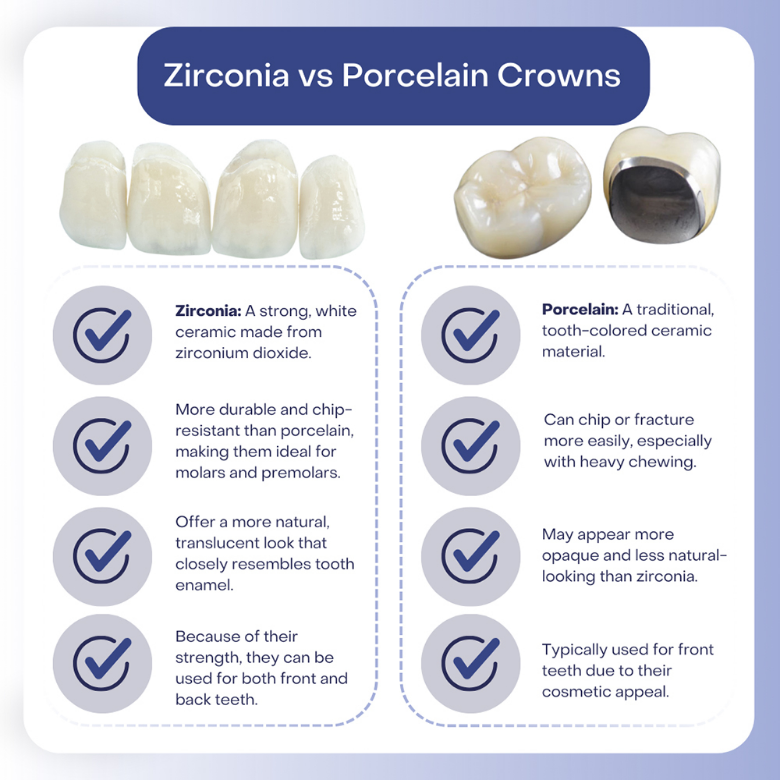
Normally a zirconia material crown is considered the best option for a single tooth implant , especially in molar regions as it is a combination of strength and durability. For esthetic zones, lithium disilicate crowns, which is basically a material having glass- like transparency features, are preferred if it’s an esthetic zone case.

Zirconia vs Porcelain Crowns
image
FAQs 2

All-on-4 is a technique in which the entire upper or lower arch is restored on 4 implants.  This is suitable for people who have less bone along the arch such that 5 or 6 implants won’t fit with safe distance between them. The dental implants are strategically positioned at such angles that all vital structures like the sinus or nerve are saved and still posterior teeth can be replaced. They are designed for adults who are missing an entire upper or lower arch of teeth, or those with severely damaged teeth needing full extraction.

All-on- 6 is a technique in which entire upper or lower arch is replaced using 6 implants. The implants position in this case is more straight, equidistant and widespread, allowing a more stronger structure which can enable a wider chewing surface. It is possible in cases where there is abundant good quality bone, or in patients where we can achieve bone till backside by grafting.

  • Number of Implants: All-on-4 uses four implants per arch, while All-on-6 uses six implants.
  • Placement Angle: All-on-4 places the two front posts straight and angles the two back posts to maximize contact with available bone. All-on-6 typically uses more parallel placement distributed across the jaw.
  • Bite Force and Stability: All-on-6 spreads chewing pressure more evenly across a wider area, offering extra strength for people who grind their teeth or have strong bite forces. All-on-4 can leave back teeth with slightly less support.
  • Bone Requirements: All-on-4 is designed for patients with moderate bone loss because the angled posts avoid grafting. All-on-6 generally requires better bone density and volume to support six distinct posts.
  • Cost: All-on-4 is usually more budget-friendly, while All-on-6 costs more due to the extra hardware and potential grafting needs.

All- on- X means full mouth or both jaw replacement on 10 implants, that is, each jaw replaced on 5 implants. This is an intermediate option between All-on-4 and All-on- 6 , wherein we get better number of implants , support than All-on-4 yet while avoiding the high cost and grafting requirement ( if applicable) of All-on-6 due to use of angulated/tilted implants.

8. Comparisons, Cost & Local High-Intent Questions

Are dental implants better than dental bridges or dentures?

Dental implants replace the roots of the missing teeth , so they function like natural teeth.

Dental bridge involves grinding two healthy adjacent teeth to replace a missing tooth- this does not replace the function like natural teeth. In fact, it may overload the adjacent teeth and weaken them since they lose their enamel in the grinding process. These adjacent teeth have higher chances of failing and needing further treatment. Dentures are removable, hence they neither feel natural nor do they restore function like implants.

This depends on the quality of implant and the implant cap chosen. A basic dental implant cost starts at Rs.21,000/- while a basic acrylic/ PMMA cap starts at Rs.5000/-. A standardized international quality cap can range from Rs.30,000 to Rs.35,000 for the implant, and metal- ceramic cost can go upto Rs.7000. Ultra premium branded implants go upto Rs.50,000/- for the implants, whereas zirconia caps can range upto Rs.13,000 to Rs.18,000/-. This cost is due to use of original implants and their components, and getting caps done from standardized labs which use high-quality refined and pure materials, with quality checks from Dr.Mrunal and Dr.Madhura at every step.

The cost of an implant treatment is a combination of the various services provided along with the implant at the clinic. The higher the quality of these services, the greater the chances of treatment success and the longer the expected lifespan of the implant.

The following chart explains the various components of implant treatment, what you receive when you pay higher charges versus lower charges, and how these differences can affect the overall treatment outcome.

https://docs.google.com/spreadsheets/d/10uACiFWGBD7tzIB4z1aRNWeTGDr9Moy04Djq9Vlg2bg/edit?usp=drivesdk

A good treatment decision starts with understanding your treatment.

Patients should know what treatment is being planned, how it is expected to perform in the long run, what can fail after a few years, and what maintenance will be required.

Without proper understanding, patients may choose cheaper or quicker solutions that may not provide lasting results.

Modern technology such as 3D X-rays/CBCT provides better information to the doctor before starting treatment and can also help assess the execution of treatment.

For dental implants, CBCT-based planning allows three-dimensional evaluation and precise planning of implant placement, helping reduce the risk of complications and improving treatment predictability.

Therefore, when choosing an implant clinic, check whether the clinic uses the available technology appropriately for diagnosis and planning.

Dental implants and other dental treatment materials are purchased by the dentist for your treatment.

The materials used can affect the durability and longevity of the treatment. Higher-quality materials may cost more initially but can provide better long-term value.

Therefore, while comparing implant treatment options, understand which implant and dental materials are being used for your treatment, rather than comparing only the total price.

An excellent treatment performed today can still fail in the future if proper hygiene instructions and other instructions given by the dentist are not followed.

Routine check-ups and timely treatment are important for maintaining dental health over the long term.

A repaired part of the body also requires care and maintenance. Therefore, the patient’s role after treatment is important for maintaining the result.