
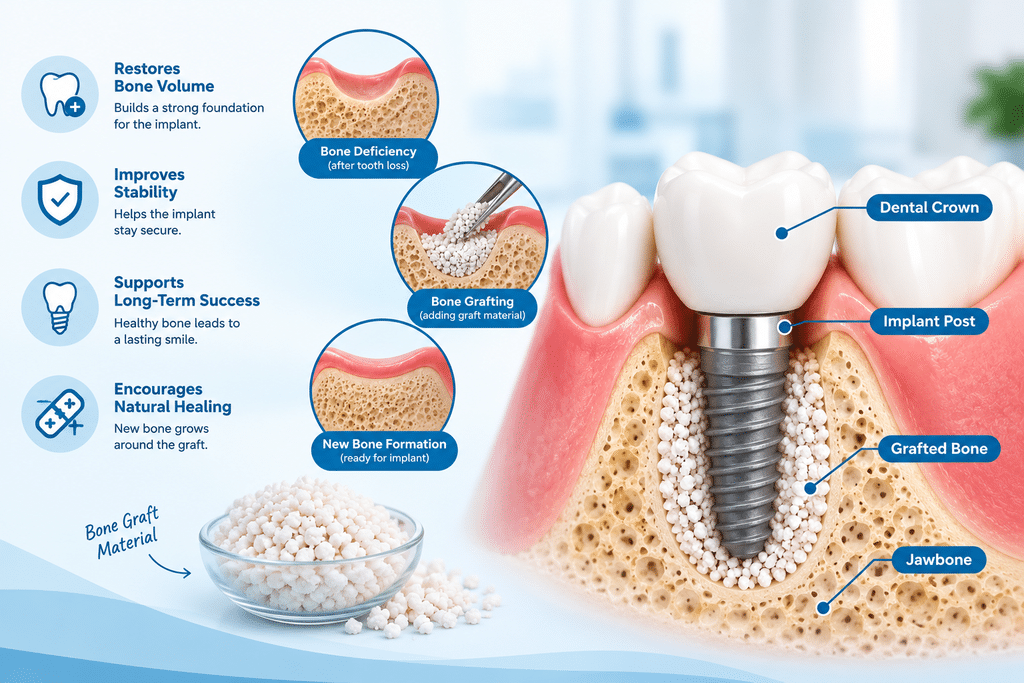
Bone grafting is a way to rebuild lacking or deficient jawbone before receiving an implant. If you are lacking in enough jawbone to support your implant, you may be a good candidate for this procedure. The requirement of this therapy relies on the condition of your bone, oral health, and also the placement of the implant.
For patients considering a dental implant, this can clarify why and when bone grafting is an integral part of the treatment. Here at Burute Dental Hospital, you can consult with our dental implant dentist in Pune to discuss the available options.
What Is Bone Grafting for Dental Implants?
Implants are small metal posts that are placed into the jawbone in the space of teeth that are missing. Implants must be well supported by jawbone during their healing phase to be stabilized and the jawbone can shrink in size following an extraction or a tooth loss. Gum disease, infections, and injuries to the mouth, all can result in loss of bone.
A dental bone graft involves putting grafting material into an area that needs more bone support or volume. The graft material provides a support system over time that can facilitate the body’s natural bone-healing process. The aim is to augment the existing bone structure to allow the dentist to decide whether an implant can be placed and, if so, to choose the best approach.
When Is Bone Grafting Needed Before Dental Implants?
Not all patients require a bone graft before getting dental implants. This is determined by the quantity and quality of jawbone in the area of the future implant.
- When Tooth Loss Has Caused Bone Shrinkage
Jawbone stimulation comes from the natural chewing activity of the teeth. Bone loss can occur in the jaw after a tooth has been removed. A graft can also be used if not enough bone is present in an area to achieve the proper volume for the implant.
- When Gum Disease Has Damaged the Bone
Tooth loss from periodontal disease will cause loss of bone and tissues that support teeth. Bone loss from periodontitis can impact implant site development in the event of the need for a tooth extraction. The dentist will evaluate the bones and gum tissue that are still present before suggesting any treatment.
- When There Is Not Enough Bone Width or Height
There must be enough width and height of bone in the jaw for your implant to be secured safely. Some people are born with a very narrow jaw ridge or do not have enough bone height in the necessary area. Bone grafting can supplement these deficiencies. A sinus lift may be performed for some maxillary cases, when more vertical bone height needs to be gained adjacent to the sinus.
- After Dental Trauma or Infection
Loss of bone due to injury, prior infection or otherwise, following a difficult extraction procedure can result in a deficient volume of bone in the area. A decision to have bone grafting carried out can be made depending on the site’s suitability. But if the infected tissue is more severe, the dentist will have to treat that active infection before proceeding with treatment.
How Can a Dentist Know When You Need a Bone Graft?
The only definitive way to know if you require bone grafting is by having a dental examination.
The test can involve:
- I look at the gums the hole where the tooth’s missing and the overall oral health.
- Dental X Rays: X-ray imaging lets me see the jawbone and tissues.
- A cone beam computed tomography scan gives three‑dimensional details about the size of the bone and nearby anatomical structures.
- Medical/ history: I choose a treatment plan by looking at past surgeries, medications, tobacco use and the patient’s overall health.
Based on the results I can confirm whether you can receive an implant immediately recommend a bone graft or choose another solution.
How Does a Dental Bone Grafting Procedure Work?
The specific treatment will vary depending on the amount of bone loss and where it is located. One possible treatment may include:
Step 1: Checking bone loss and planning the work
The dentist looks at how much bone has been lost and checks the scans that are needed before deciding on the grafting method.
Step 2: Prepare the Treatment Area
The area is being prepared for surgery. If it is a fit we can use local anaesthesia to lessen the pain during the operation.
Step 3: Placing the Bone Graft
The dentist puts an amount of grafting material into the spot where you want a stronger tooth. Sometimes a barrier membrane is added to protect the graft while it heals.
Step 4: Healing and Follow-Up
Further appointments are arranged to allow the site to heal and the dentist to observe the healing process. The dentist will decide if implant surgery is suitable when the site has healed. The process may also be different for patients who are candidates for bone grafting and immediate implant placement.
What are the bone graft materials used?
A few varieties of grafting materials can be used, which will be discussed along with a patient’s needs and the clinical judgment of the dentist.
- Autogenous graft: Bone graft harvested from a different site in the patient’s own body.
- This is the section of the bone that has been removed from a human source.
- Xenograft: Bone substitute material derived from any non-human animal.
- Synthetic graft: A genetically engineered graft that replaces bone.
All of the options have their own attributes and pros and con’s. The best choice of material would depend on the site of treatment and the volume of bone required as well as the opinion of the clinician.
Patients should talk to the dentist about what the material is, where it comes from, and why they should use it.
How Long Does a Bone Graft Take to Heal?
Healing times for the graft may depend upon its size and location and whether the particular graft is self or other sourced, as well as the patient’s healing response. The swelling and tightness generally lessen during the first few days to two weeks. The bone itself may take a few months to heal to the level where implants can be placed. Larger grafts may take even longer.
Post-op patient can follow the dentist instructions, practice good oral hygiene, avoid to disturb the surgery areas and make the follow up appointments. Health problems, smoking, smoking cigarettes and other factors can affect healing. Otherwise, if there are symptoms that “get worse ” rather than gradually get better, or if fever, other types of abnormal discharge or any other signs of getting worse, notifies the dentist immediately.
Can you place Dental Implants with Bone Graft?
Sometimes, a dentist may perform the bone grafts and implant at the same time. The decision to do this depends on how much of the existing bone. There has to be enough bone to hold the implant and be confident that the defect can be filled. If the bone loss is bad enough, then the dentist will take the less risky option and recommend that you get a bone graft before implant and another healing period.
No single approach will be successful for all cases. The sequence of the procedures should be based on clinical exam, x-ray and needs of the planned restoration. Seek dental assistance right away if your pain or swelling increases, bleeding lasts longer, or if an infection develops.
Cost of bone Grafting for Dental Implants in Pune
The price of bone grafting for dental implants in Pune is different for each patient. There is no fixed rate of bone grafting for all cases.
The price may vary due to:
- The extent of the remaining existing bone that will be grafted.
- The material used for grafting and how much is applied.
- Whether either membrane or additional step at this time.
- (if the implant is placed at the same time.
- The complexities of the case, namely due to it being high-profile, and the follow-up requirements.
A consultation with a dentist will help determine the cost of a dental implant. It also provides a better idea of the treatment to be performed. Patients are encouraged to request detailed information about the treatment plan.
Frequently Asked Questions
Is bone grafting always necessary, before implants?
No. Bone grafting is not always needed. If there is bone to support the implant grafting can be avoided. The dentist will check the bone level using an exam and imaging tests to decide.
Does bone grafting hurt?
During the procedure, a local anesthetic will usually be given. There is likely to be some tenderness, swelling and discomfort afterwards and it is difficult to predict how long it will take to recover.
Is it possible to have dental implants after losing bone?
Maybe. If the bone deterioration is significant or affecting the entire jaw, there may be the option of bone grafting or a different plan of implant treatment. An assessment is needed.
How long does it take before an implant can be placed after bone graft?
The length of time you will need to wait will depend on the size and placement of the graft and your body’s rate of healing. It could take some months before your implant is placed.
Will bone grafting ensure dental implant success?
No procedure is guaranteed. Bone grafting will provide additional support for the bone but factors such as your overall health, healing, implant planning and maintenance play a part as well.
When is bone grafting needed for dental implants?
In some cases of dent al implants, the procedure is carried out because the jawbone is not long enough, wide enough, or has not got enough volume. In most cases, the reasons for a b one graft are due to teeth loss, removal, injury or advanced periodontitis. The dentist or oral specialist will check the oral cavity in conjunction with the imaging by performing a clinical examination.