Dental Implant Services In Pune

Single Tooth Dental Implants

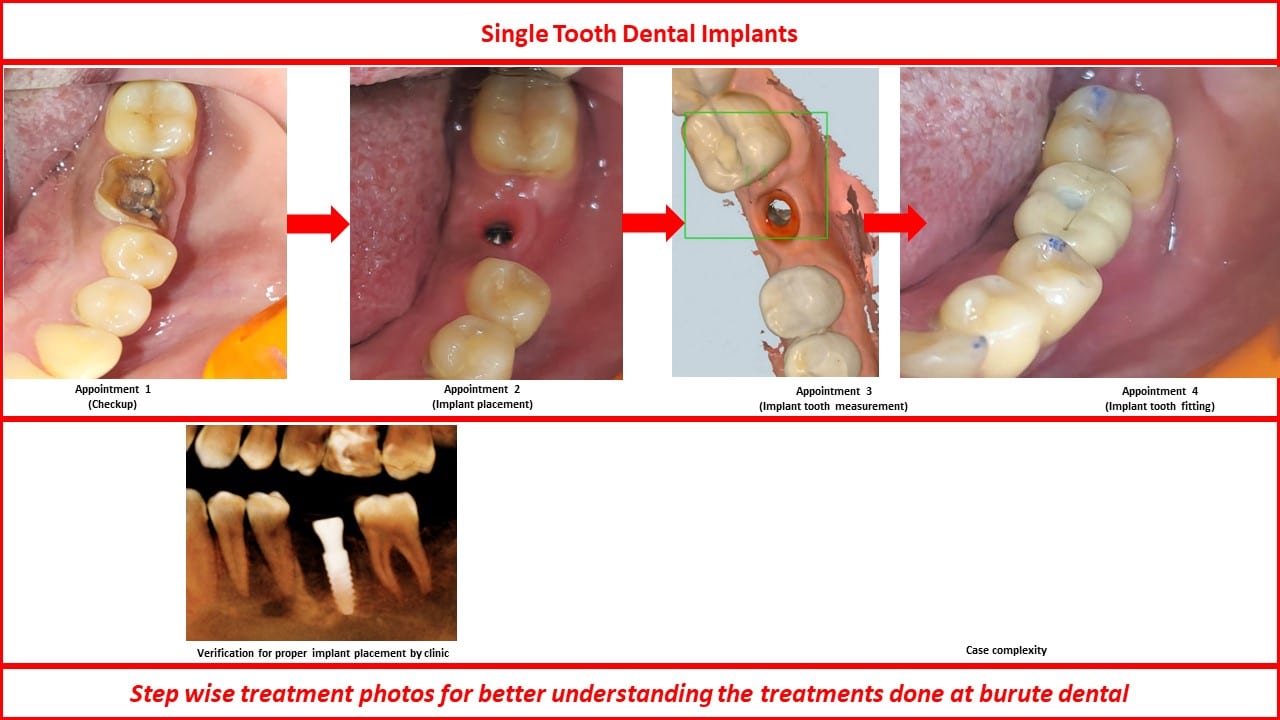
When a single tooth is missing in upper or lower jaw , a single tooth dental implant is required to replace that missing tooth

Challenges : If tooth is missing from long time the adjacent teeth move in the missing teeth space and reduce that space , the bone height and width reduces over time. These challenges are overcome by experience of surgeon in placing implants , only by old experience do a implant surgeon can predict outcome of such complex senario

dental implant services in Pune
Services 42

Osstem / Neodent / Dentsply / Neobiotech – ₹21,000
Nobel Biocare / Straumann / Zimmer – ₹35,000

Multiple Tooth Dental Implants

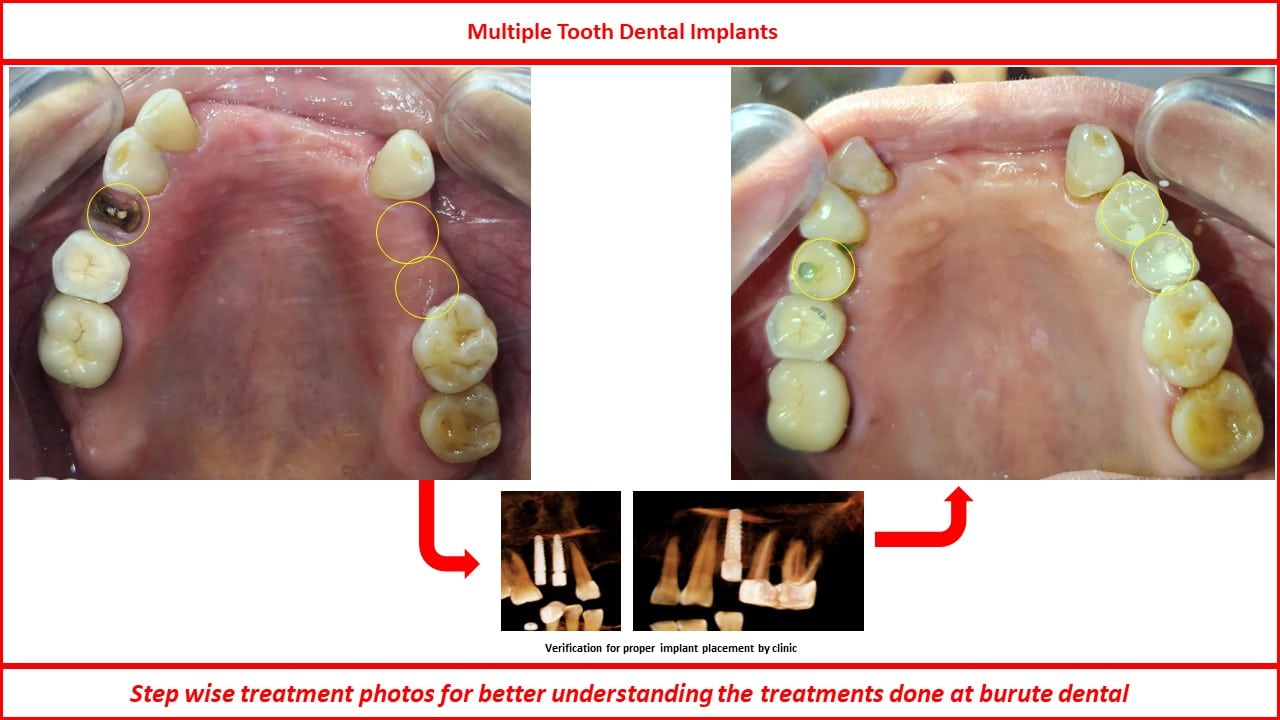
When several teeth are missing, dental implants can be used to replace the missing teeth without necessarily placing one implant for every missing tooth. 

Depending on the position of the missing teeth and available bone, individual implants or an implant supported bridge can be planned. 

The condition of the gums, amount of bone and biting forces have to be considered before treatment. 

At Burute Dental, we assess the complete area clinically and with CBCT and plan the number and position of implants according to the patient’s requirement. 

Slide2
Services 43

Osstem / Neodent / Dentsply / Neobiotech – from ₹21,000/implant
Nobel Biocare / Straumann / Zimmer – from ₹35,000/implant

Full Mouth Dental Implants

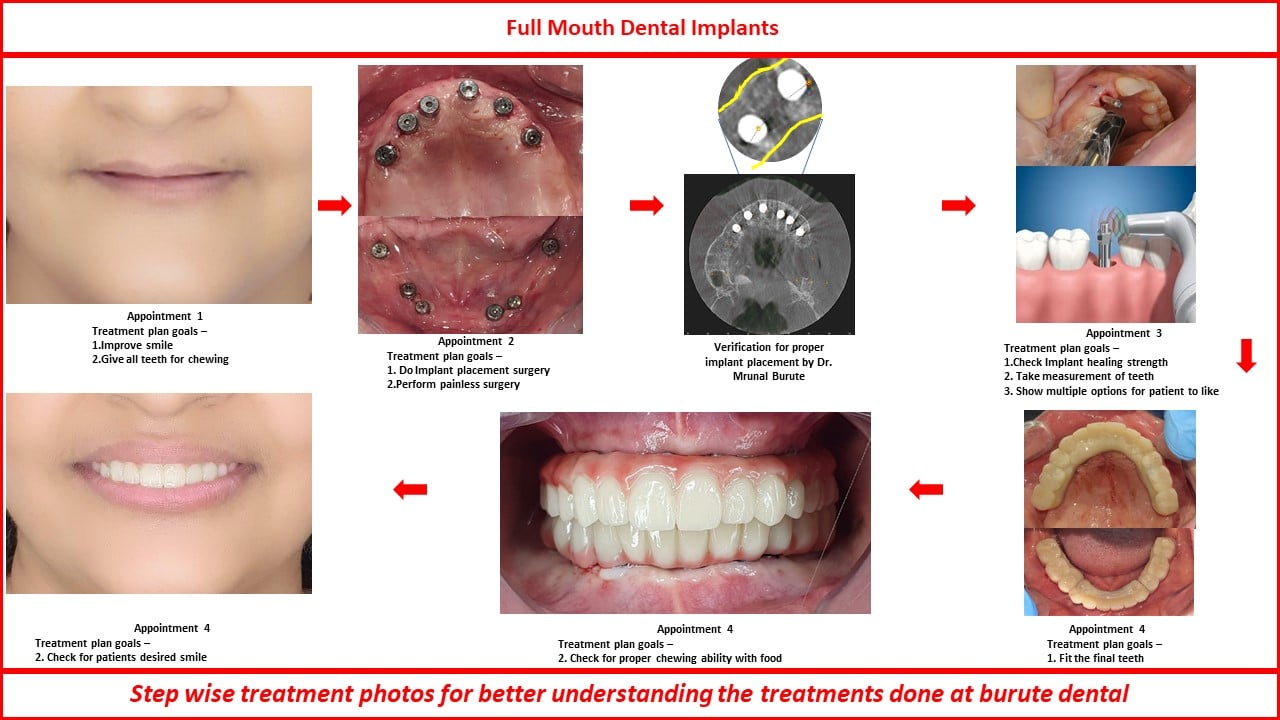
When most or all teeth are missing or badly damaged, full mouth implant rehabilitation can be used to replace the teeth and restore chewing function. 

Full mouth implant treatment is not simply about placing implants. The bite, bone, gum condition, implant position and final teeth all have to be planned together. 

Some patients may require bone grafting or other procedures before or along with implant treatment. 

At Burute Dental, we assess the complete mouth with clinical examination, photographs, X-rays and CBCT and prepare a comprehensive treatment plan according to the patient’s condition. 

Slide3
Services 44

Treatment cost is case based
Final quote after clinical examination, CBCT and treatment planning

All-on-4 Dental Implants

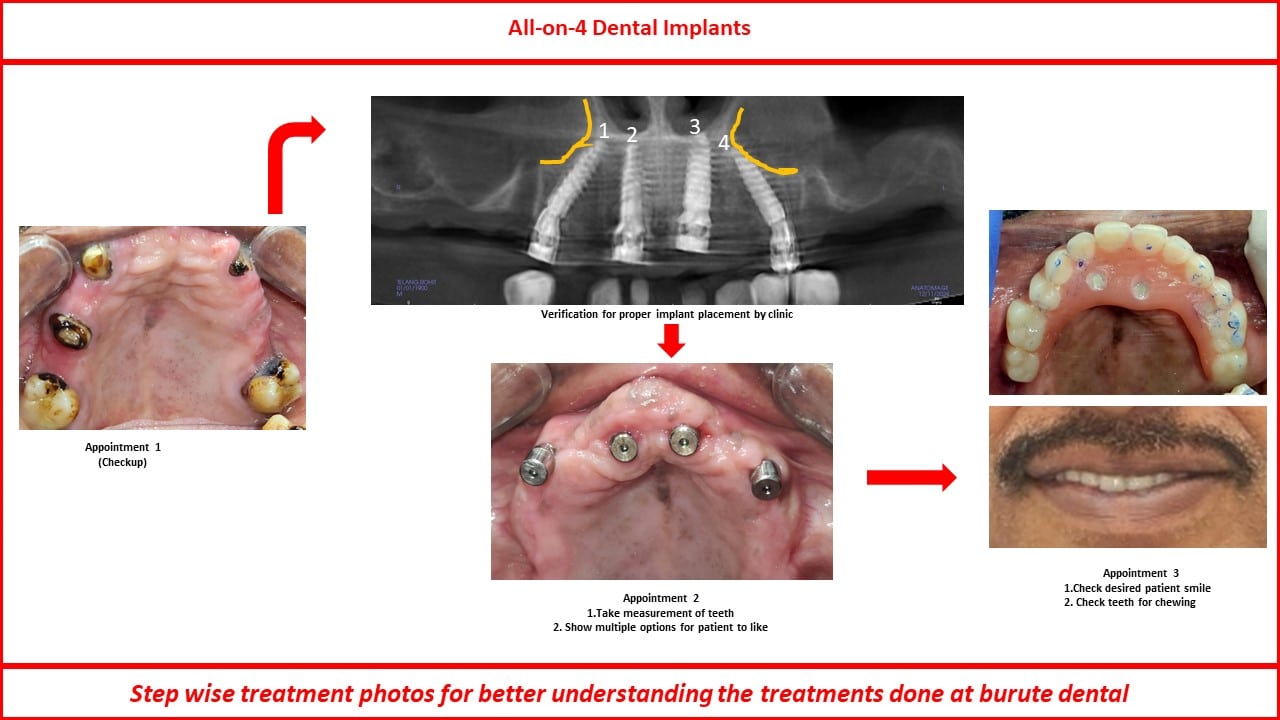
All-on-4 is a treatment concept used to replace a complete arch of missing or severely damaged teeth using four strategically planned dental implants. 

In selected patients, the available bone can be used to avoid extensive bone grafting. 

The position and angulation of the implants are very important because all the teeth are supported by these implants. 

At Burute Dental, we assess the complete jaw with clinical examination and CBCT and plan the implant positions according to the available bone and final teeth. 

Slide4
Services 45

Package pricing is case based
Final quote after CBCT, implant planning and prosthetic design

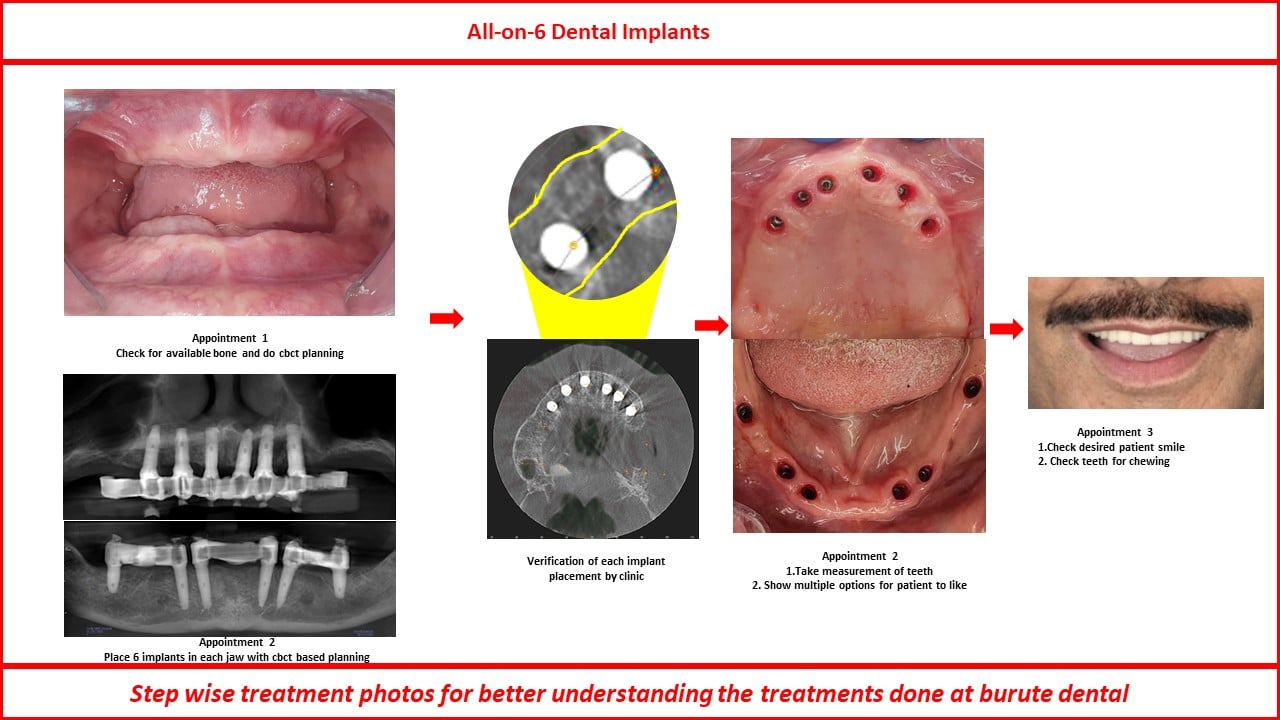
All-on-6 Dental Implants

All-on-6 is a full arch implant treatment concept where six dental implants are used to support a complete set of teeth. 

Using six implants can provide multiple points of support for the final teeth in selected patients. 

The available bone, implant position, bite and condition of the jaw have to be assessed before deciding whether All-on-6 is suitable. 

At Burute Dental, we use clinical examination and CBCT to assess the jaw and plan the implants and final teeth according to the patient’s individual requirements. 

Slide6
Services 46

Package pricing is case based
Final quote after CBCT and complete treatment planning

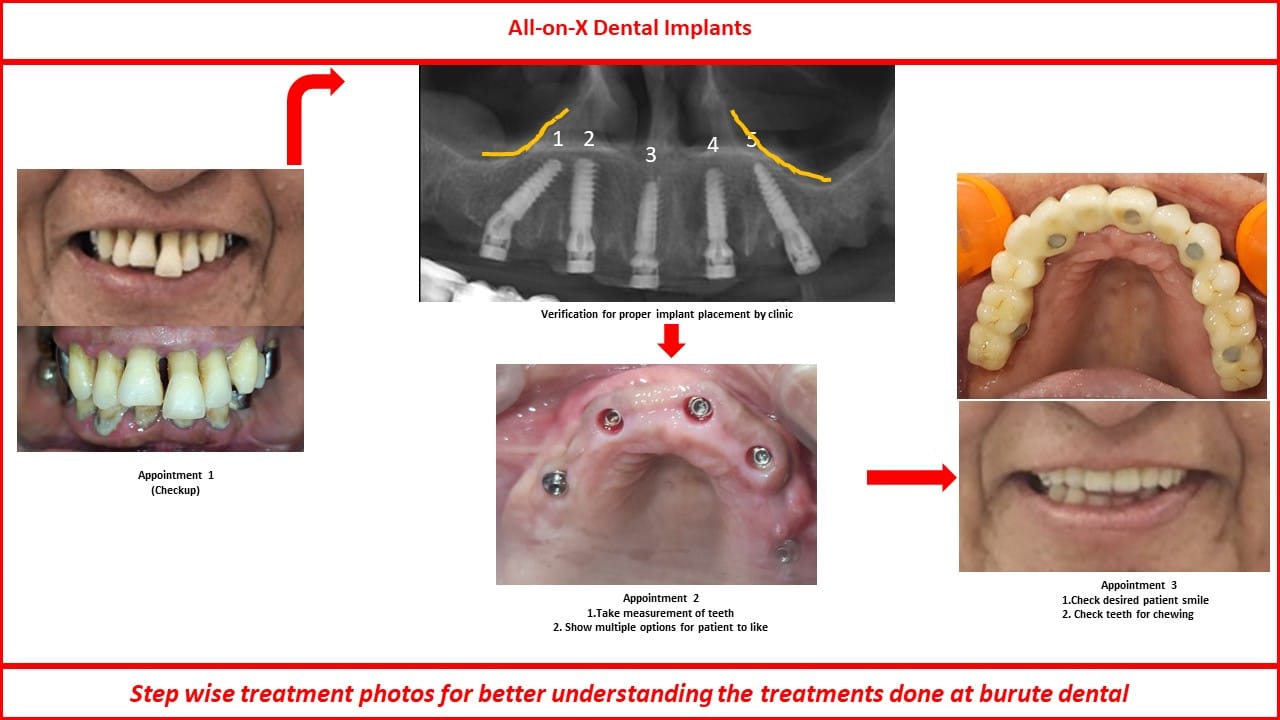
All-on-X Implant Rehabilitation

All-on-X is a full arch implant treatment concept where five dental implants are used to support a complete set of teeth.

An additional implant can provide another point of support and may be considered when the patient’s bone condition and treatment requirements allow it.

The number and position of implants should be decided according to the patient’s individual bone condition rather than using the same plan for every patient.

At Burute Dental, we assess the jaw with CBCT and plan the implant positions and final teeth according to the available bone and biting forces.

Slide5
Services 47

Customized package pricing
Final quote after CBCT, implant planning and prosthetic assessment

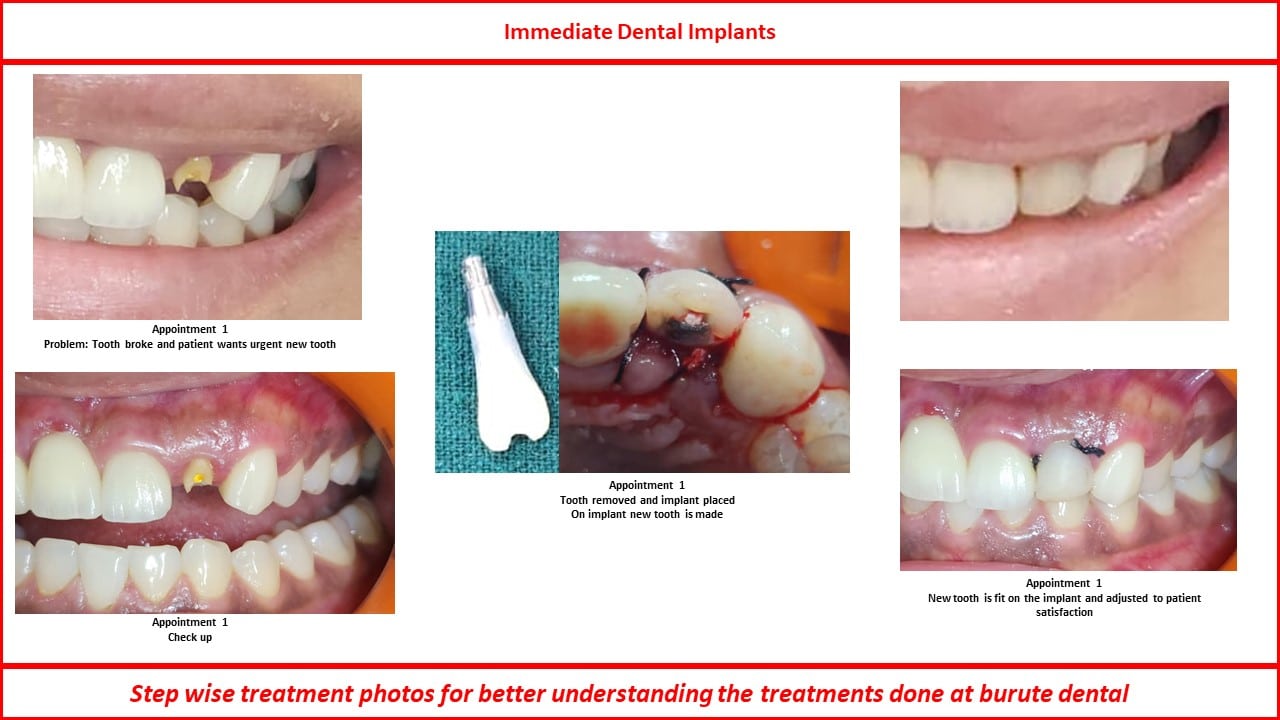
Immediate Dental Implants

In selected cases, a dental implant can be placed immediately after removal of a tooth. 

This is called immediate implant placement and can reduce the time between tooth removal and implant placement. 

However, immediate implant placement is not possible in every case. Infection, bone loss, gum condition and available bone have to be assessed before deciding. 

At Burute Dental, we evaluate the tooth and surrounding bone clinically and with CBCT and decide whether immediate implant placement is suitable. 

Slide7
Services 48

Implant charges + procedure charges as applicable
Final quote after clinical and CBCT assessment

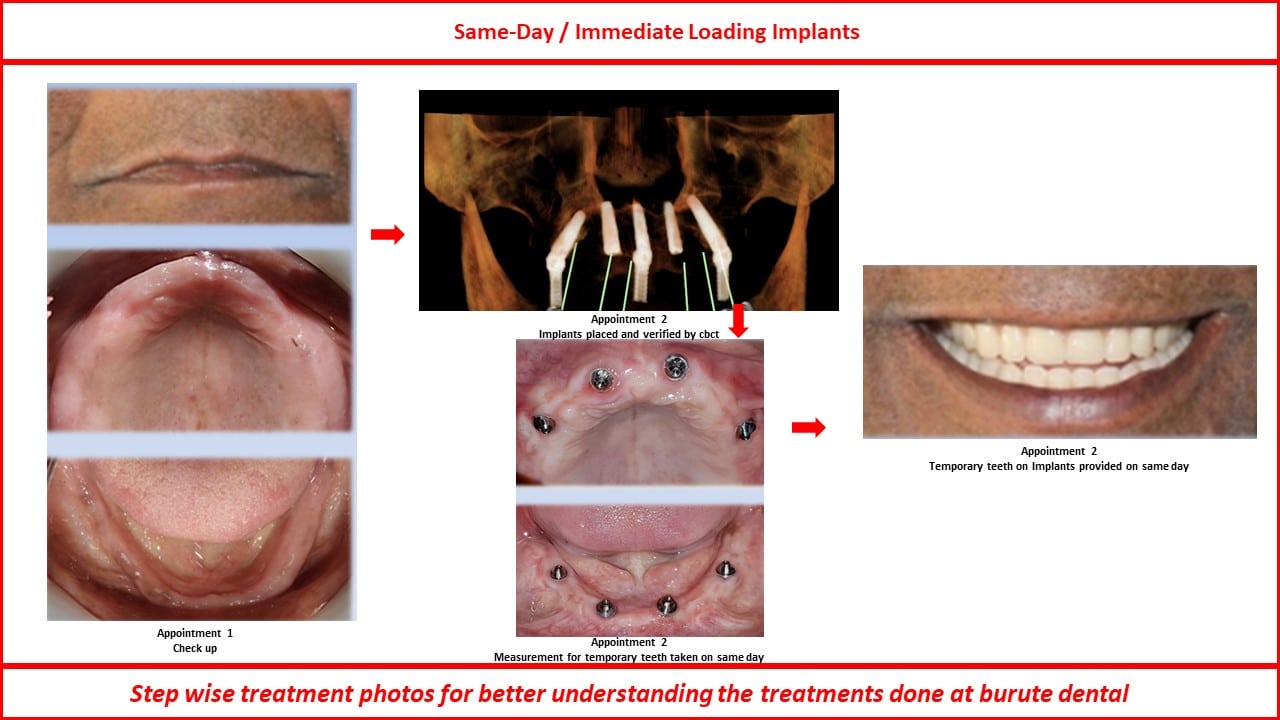
Same-Day / Immediate Loading Implants

In selected cases, the implant can be placed and temporary teeth can be fixed on the same day. 

This is called immediate loading and it allows the patient to have teeth without waiting for the complete healing period. 

However, immediate loading is not suitable for every patient. Good primary stability of the implant, adequate bone and proper control of biting forces are important. 

At Burute Dental, we assess the bone and implant stability before deciding whether same day immediate loading is suitable for the patient. 

Slide8
Services 49

Package pricing is case based
Final quote after CBCT, implant stability and prosthetic planning

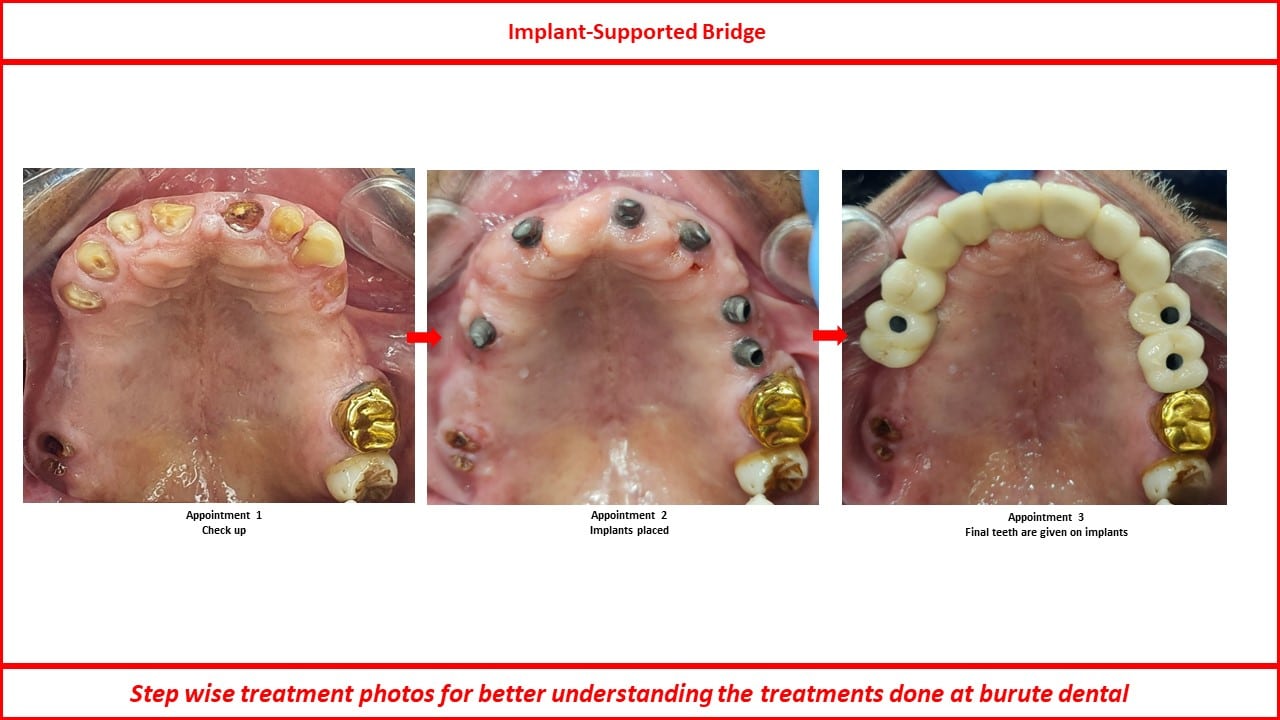
Implant-Supported Bridges

When multiple teeth are missing next to each other, it may not always be necessary to place one implant for every missing tooth. 

An implant bridge uses dental implants to support multiple replacement teeth. 

The number and position of implants depends on the amount of available bone, location of missing teeth and biting forces. 

At Burute Dental, we assess the complete area with clinical examination and CBCT and plan the implant bridge according to the patient’s individual requirement. 

Slide9
Services 50

Implant + bridge charges based on the planned design
Final quote after examination and CBCT

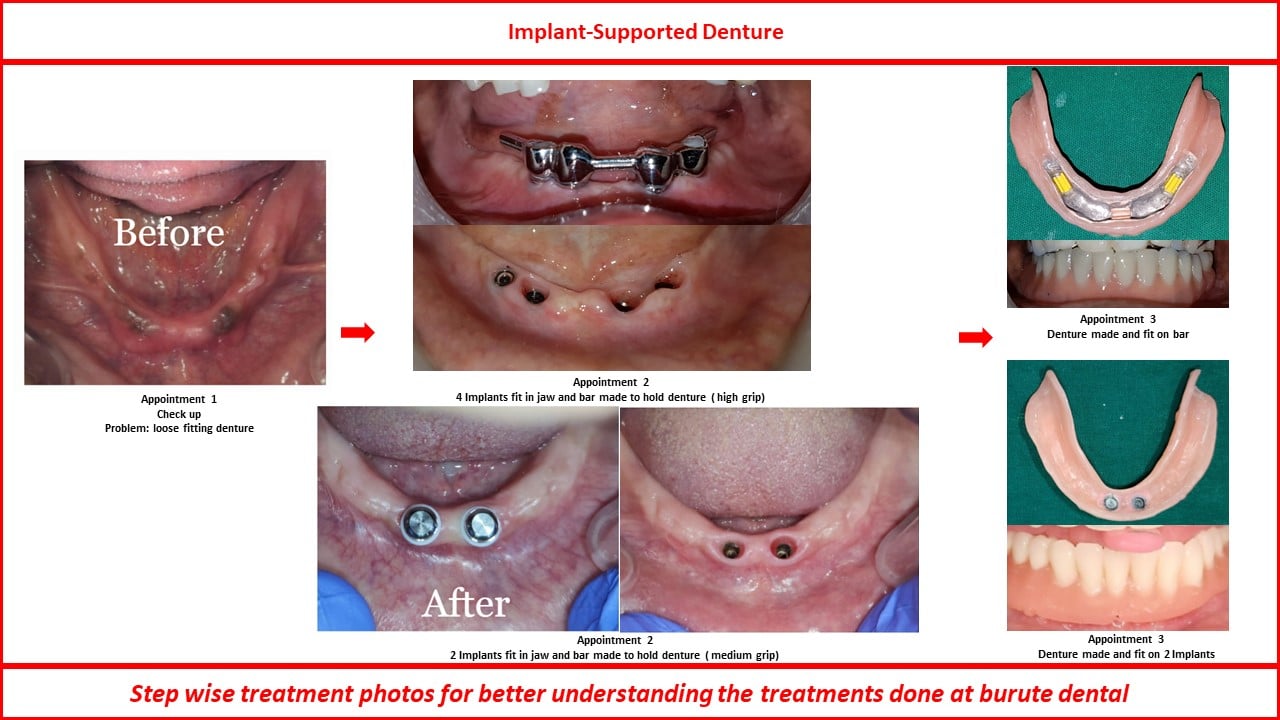
Implant-Supported Dentures

A conventional denture can sometimes move while eating or speaking, especially when there is severe loss of jaw bone. 

An implant overdenture uses dental implants to provide additional support and retention to the denture. 

The denture can be made removable by the patient but remains more stable during normal use. 

At Burute Dental, the number and position of implants are planned according to the available bone, jaw condition and patient’s requirement. 

Slide10
Services 51

Implant + denture charges based on design
Final quote after examination and treatment planning

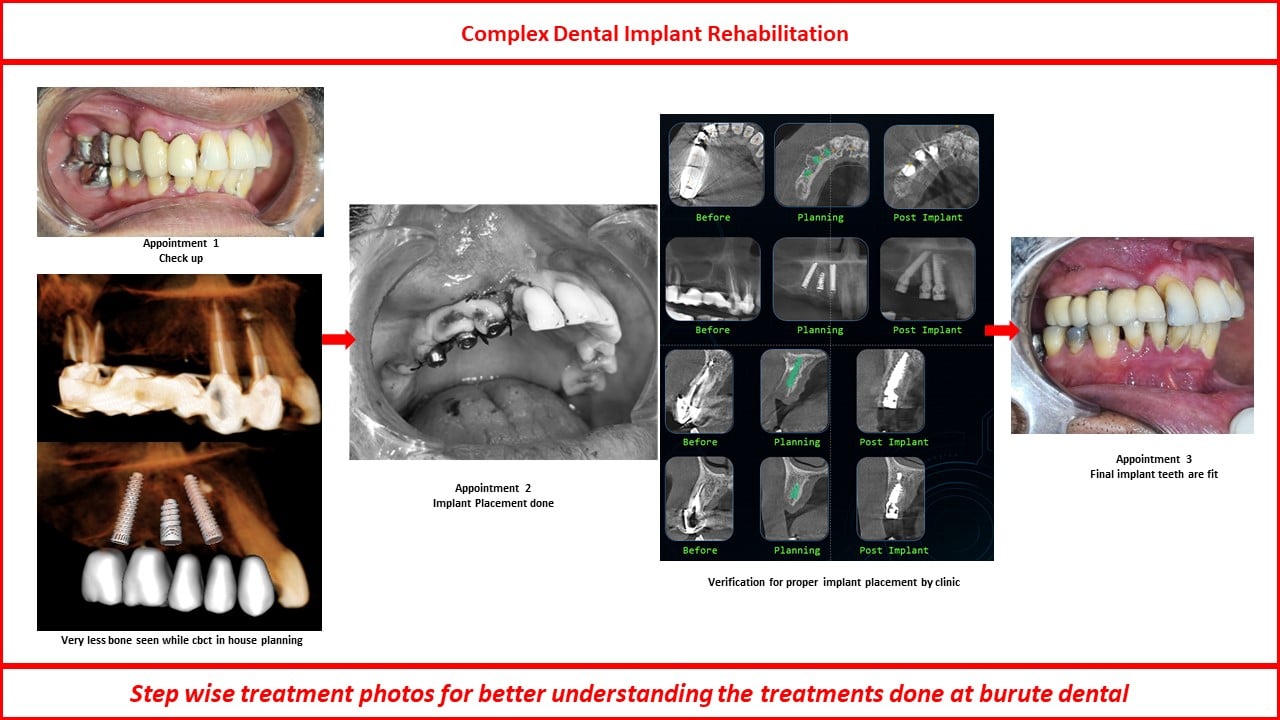
Complex Dental Implant Rehabilitation

Some patients have multiple missing teeth, severe bone loss, failed implants, poor gum condition or badly positioned existing teeth. These cases require more than simply placing dental implants. 

Complex implant rehabilitation requires planning of bone, implants, gums, bite and final teeth together. 

In such cases, treatment may involve bone grafting, removal of failed implants, multiple implants and customised prosthetic solutions. 

At Burute Dental, we evaluate the complete condition of the mouth with clinical examination, photographs, X-rays and CBCT and prepare a step by step treatment plan according to the patient’s requirements. 

Slide11
Services 52

Customized treatment package
Final quote after CBCT and complete rehabilitation planning

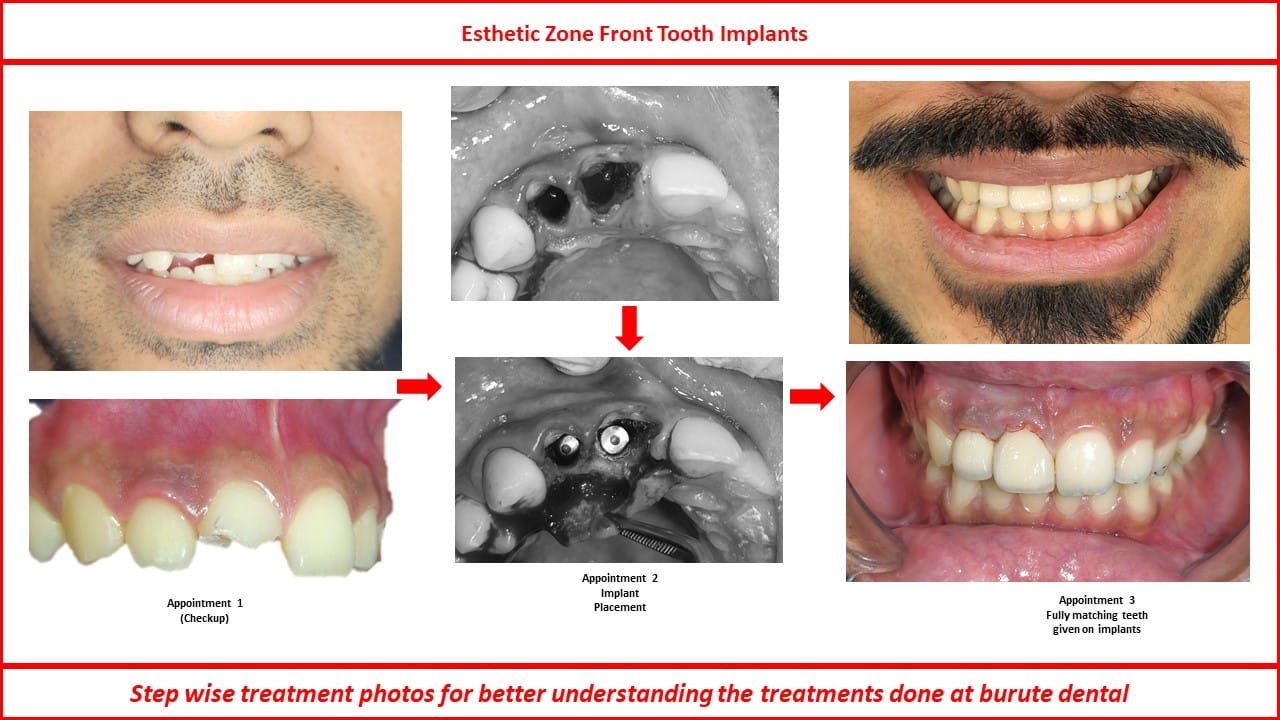
Esthetic Zone / Front Tooth Implants

Replacing a front tooth with a dental implant is different from replacing a back tooth because appearance is very important. 

The position of the implant, gum level, bone thickness, tooth shape and colour all have to be considered to achieve a natural looking result. 

Even a small error in implant position can affect the final appearance of the front tooth. 

At Burute Dental, front tooth implant treatment is planned using clinical examination, photographs, X-rays and CBCT. The implant and final crown are planned together to achieve proper function and aesthetics. 

Slide12
Services 53

Implant + customized esthetic crown charges
Final quote after clinical and CBCT assessment

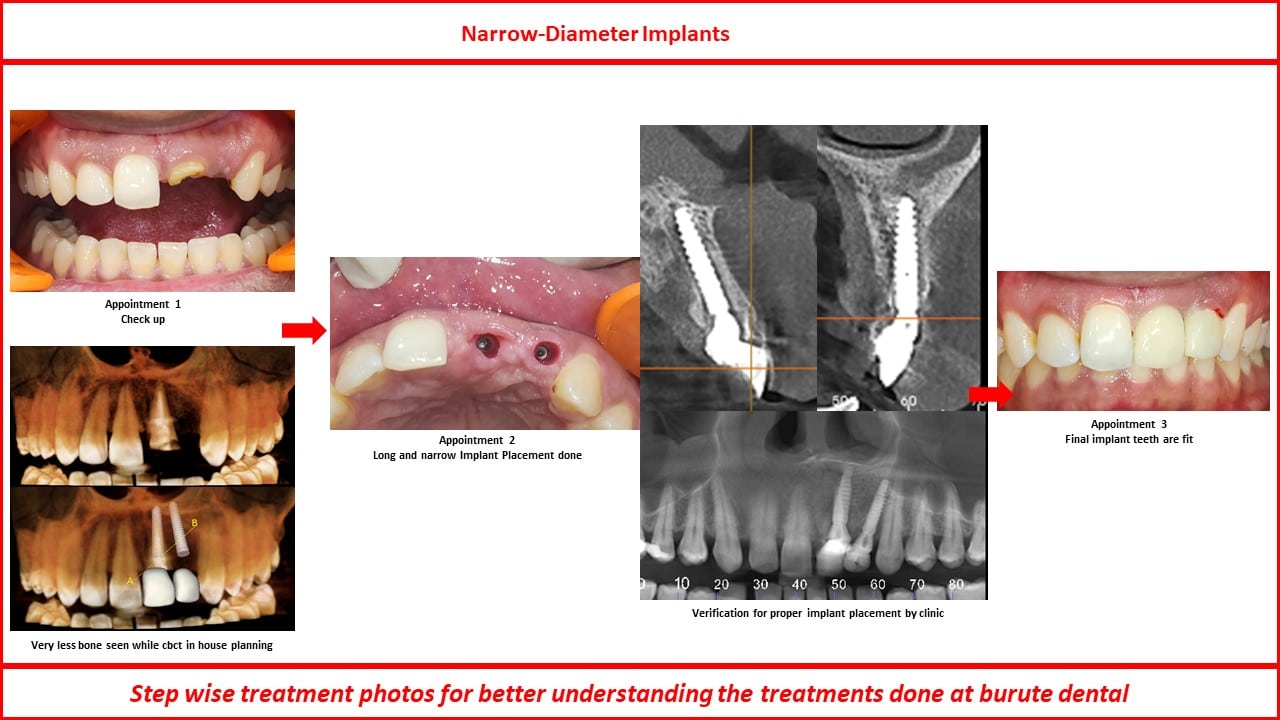
Narrow-Diameter Implants

In some patients the jaw bone is very narrow and there may not be enough width for a conventional dental implant. 

A narrow diameter implant is a smaller diameter implant which can be considered in selected cases where the available bone is limited. 

It is not suitable for every situation and proper assessment of bone quantity, implant position and biting forces is important. 

At Burute Dental, we assess the available bone with CBCT and decide whether a narrow diameter implant can provide a suitable solution for the patient. 

Narrow-diameter implants
Services 54

Implant cost based on selected system
Final quote after examination and CBCT

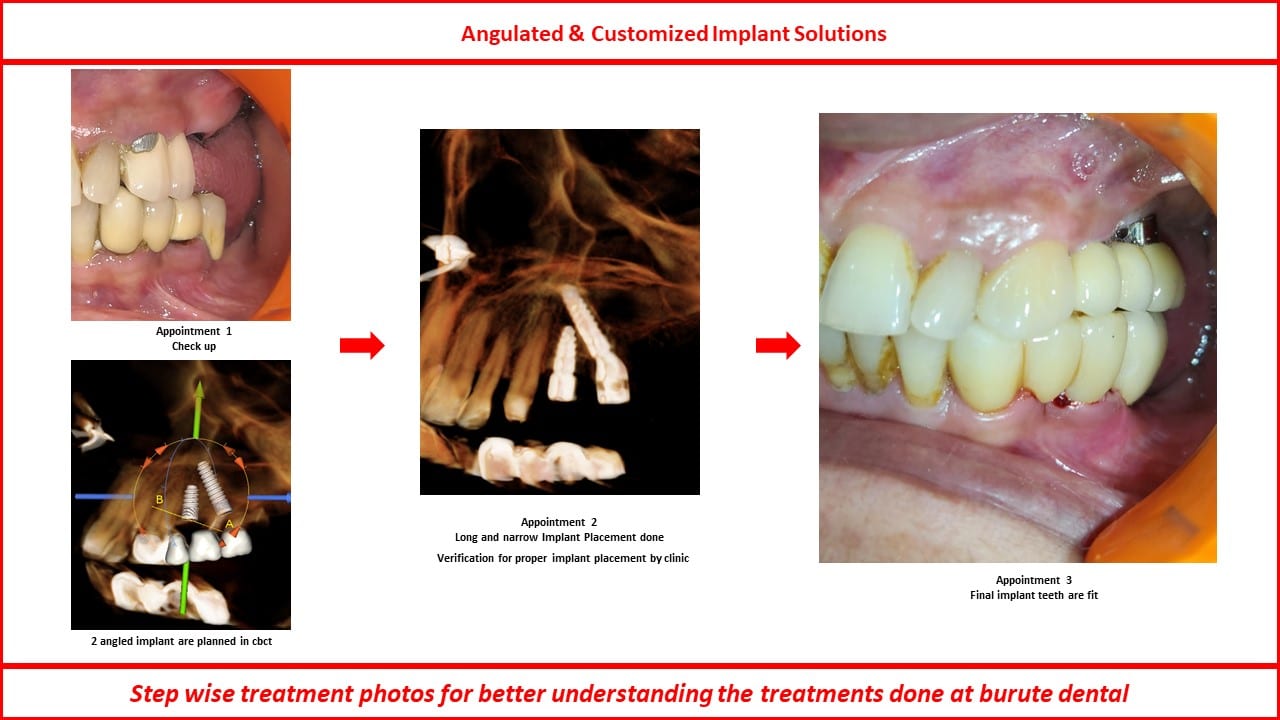
Angulated & Customized Implant Solutions

Sometimes the available jaw bone is not in the ideal position or there is severe bone loss. In such cases, placing a conventional straight implant may not be possible without extensive bone grafting. 

Angulated or customised implant solutions can be used in selected cases to make use of the available bone. 

These cases require detailed planning because the implant position, angulation, prosthesis and biting forces all have to be considered together. 

At Burute Dental, we use clinical examination and CBCT to study the available bone and plan a customised implant solution according to the individual patient’s anatomy. 

Slide14
Services 55

Customized implant + prosthetic treatment
Final quote after CBCT and digital planning

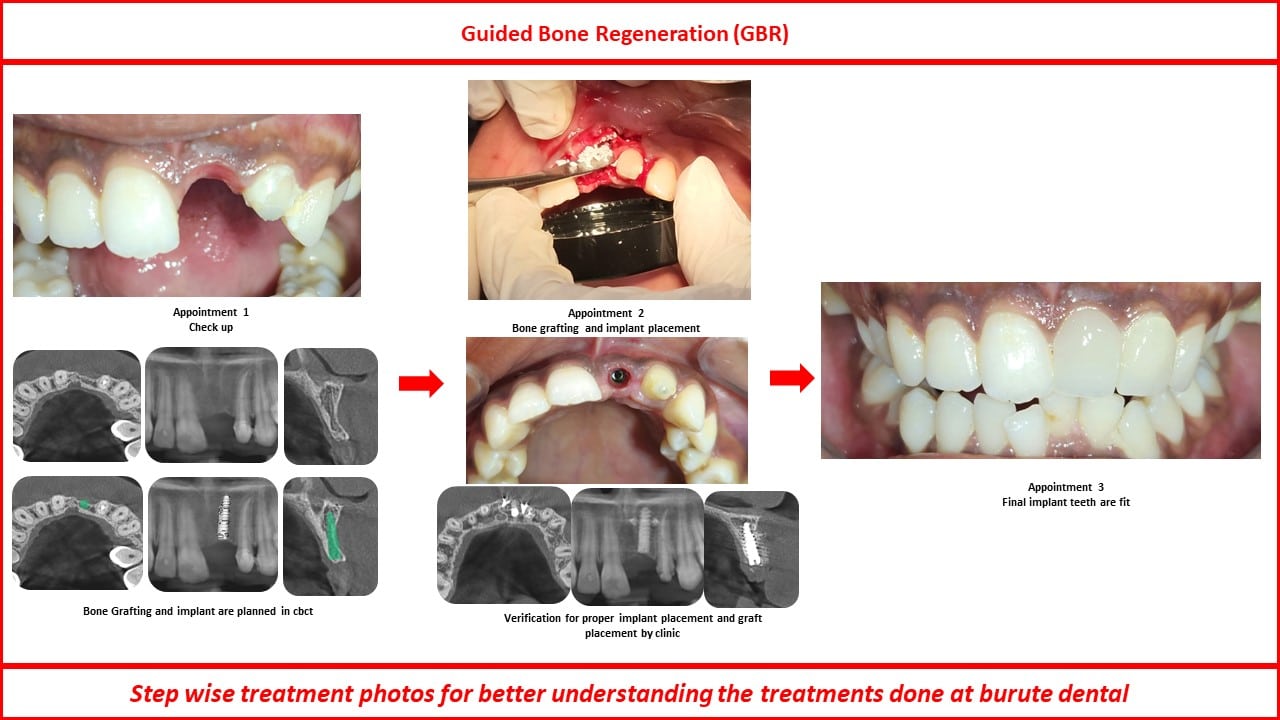
Guided Bone Regeneration (GBR)

Sometimes the available jaw bone is not in the ideal position or there is severe bone loss. In such cases, placing a conventional straight implant may not be possible without extensive bone grafting. 

Angulated or customised implant solutions can be used in selected cases to make use of the available bone. 

These cases require detailed planning because the implant position, angulation, prosthesis and biting forces all have to be considered together. 

At Burute Dental, we use clinical examination and CBCT to study the available bone and plan a customised implant solution according to the individual patient’s anatomy. 

Slide15
Services 56

Graft + membrane + procedure charges based on site
Final quote after CBCT and clinical assessment

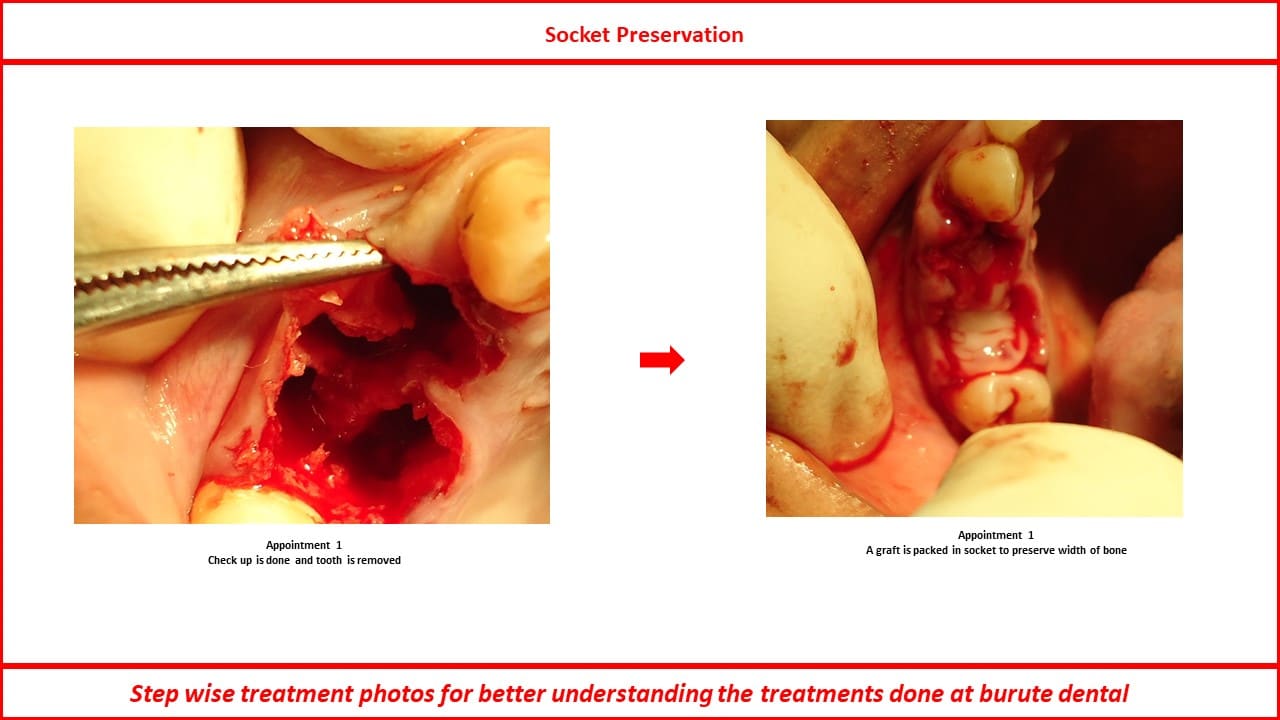
Socket Preservation

After removal of a tooth, the bone surrounding the tooth socket starts to shrink. This loss of bone can make future implant placement more difficult.

Socket preservation is a procedure done at the time of tooth removal to reduce the loss of bone and preserve the shape of the socket.

It is especially useful when an implant is planned for the future but cannot be placed immediately.

At Burute Dental, the socket is assessed after tooth removal and bone grafting is planned when clinically required to preserve the available bone for future implant treatment.

Slide16
Services 57

Graft + procedure charges based on site
Final quote after examination

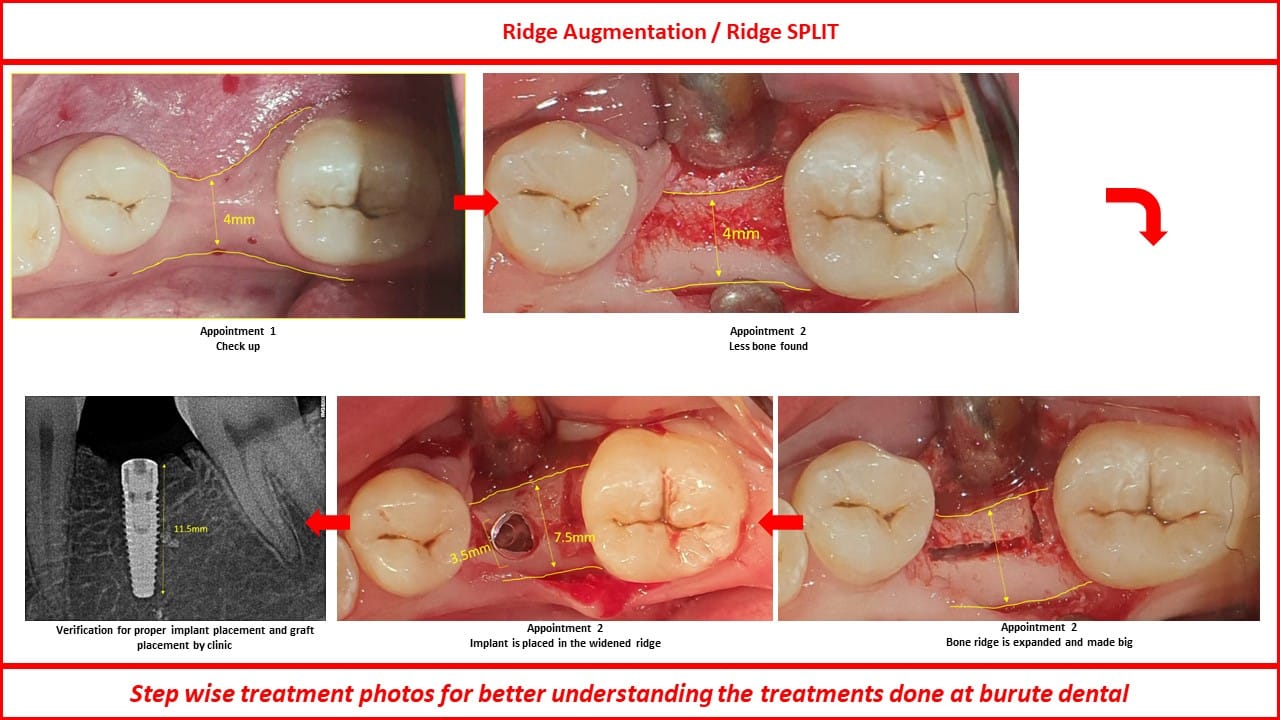
Ridge Augmentation

After loss of teeth, the jaw bone gradually becomes thin and shrinks. This can make the ridge too narrow or deficient for proper implant placement.

Ridge augmentation is done to rebuild the deficient part of the jaw bone and create a better foundation for dental implants.

The type of augmentation depends on whether the bone deficiency is in width, height or both.

At Burute Dental, we assess the ridge with CBCT and plan the grafting procedure according to the amount of bone required for proper implant placement.

Slide17
Services 58

Graft + membrane + surgical charges
Final quote after CBCT and site assessment

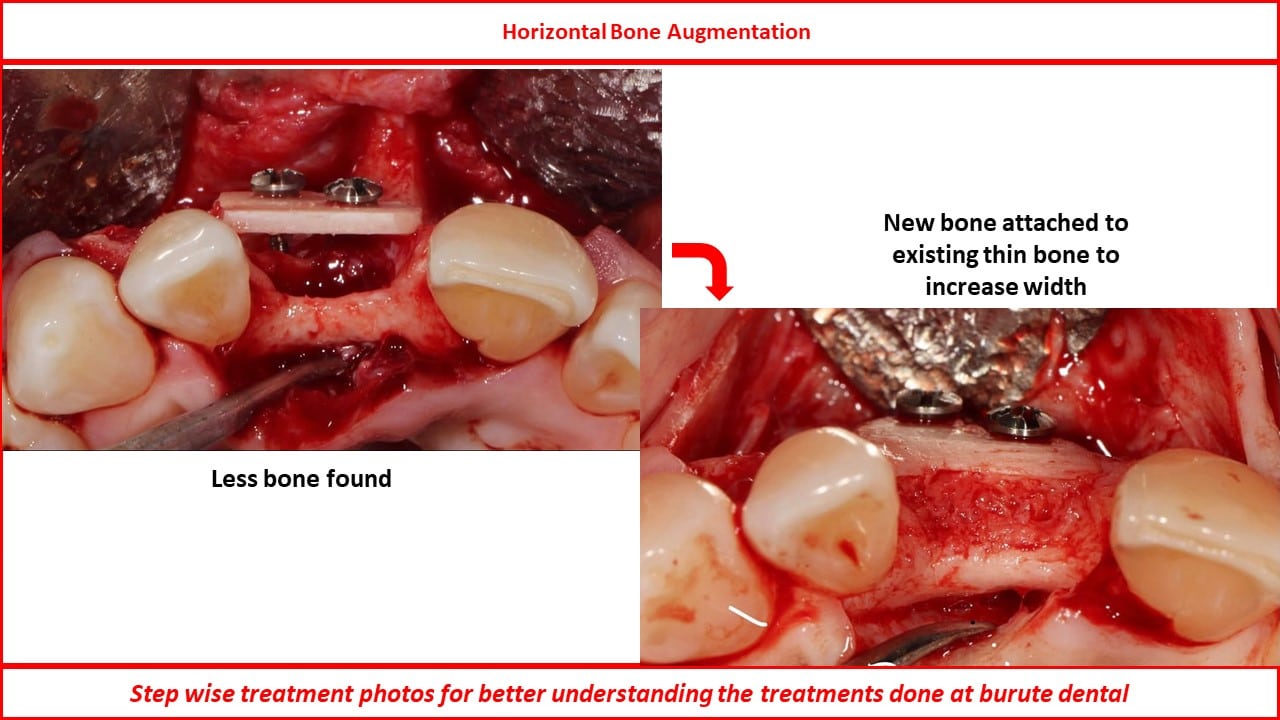
Horizontal Bone Augmentation

Sometimes the jaw bone has adequate height but is too thin in width to accommodate a dental implant properly.

Horizontal bone augmentation is done to increase the width of the jaw bone and create adequate bone around the implant.

The procedure requires proper assessment of the existing bone and careful placement and stabilization of the graft.

At Burute Dental, we use clinical examination and CBCT to assess the width of bone and plan the required augmentation before implant placement.

Slide18
Services 59

Graft + membrane + procedure charges
Final quote after CBCT and clinical planning

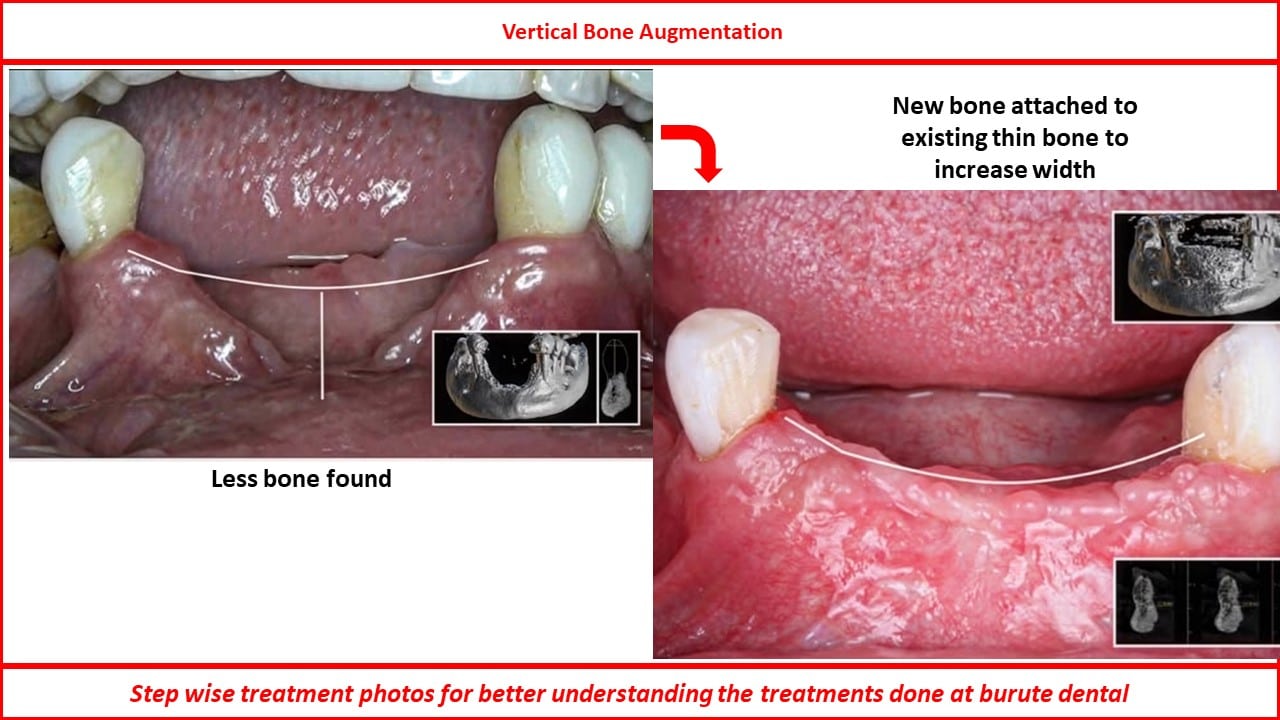
Vertical Bone Augmentation

When the jaw bone has lost its height, there may not be enough vertical bone available for proper implant placement.

Vertical bone augmentation is used to increase the height of the available bone in selected cases.

It is a highly technique sensitive procedure because the amount of bone required, blood supply, graft stability and healing are important factors.

At Burute Dental, we assess the vertical bone loss with CBCT and plan the augmentation according to the implant requirement. The healing is evaluated before proceeding with the next stage of implant treatment.

Slide19
Services 60

Customized grafting procedure
Final quote after CBCT and surgical planning

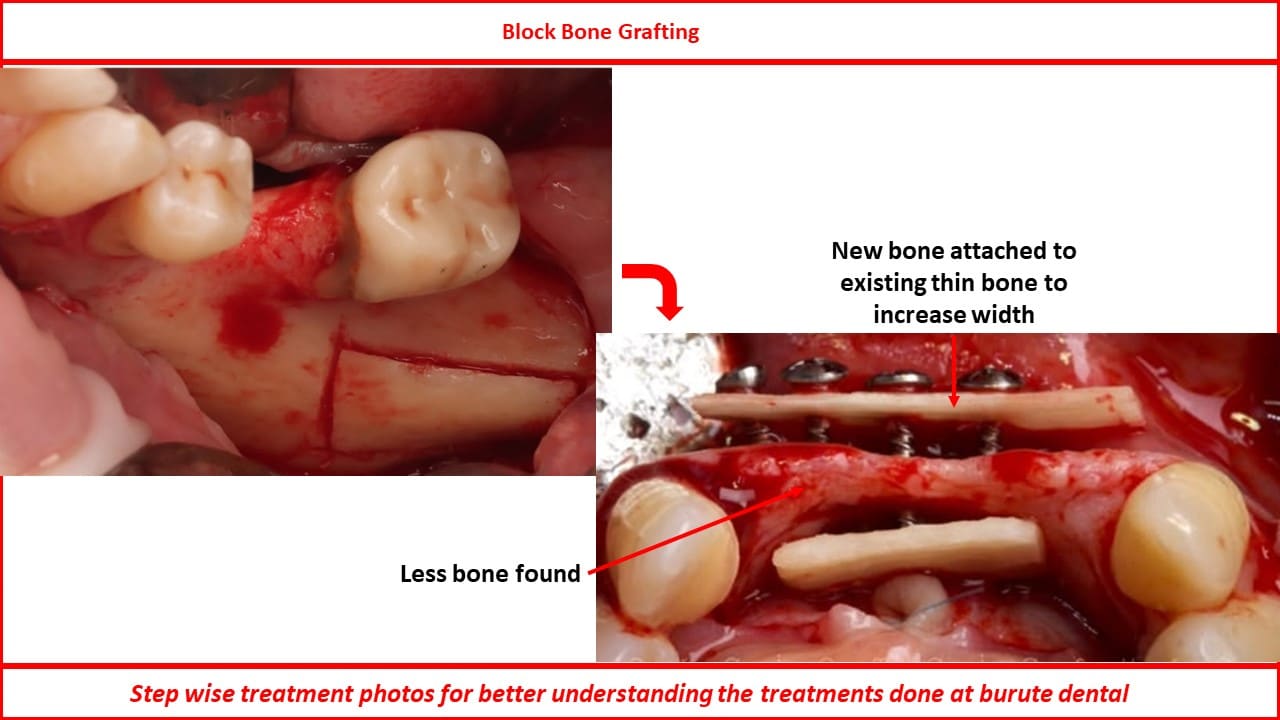
Block Bone Grafting

When there is a large deficiency of jaw bone, routine bone grafting may not provide enough volume of bone.

Block grafting is a technique where a block of bone is fixed to the deficient area to increase the width or height of the jaw bone.

It is a technique sensitive procedure and proper fixation, blood supply and healing of the graft are important for successful treatment.

At Burute Dental, we assess the exact amount of bone deficiency with CBCT and plan the block graft according to the implant requirement. The implant is placed after adequate healing when required.

Slide20
Services 61

Block graft + fixation + procedure charges
Final quote after CBCT and surgical assessment

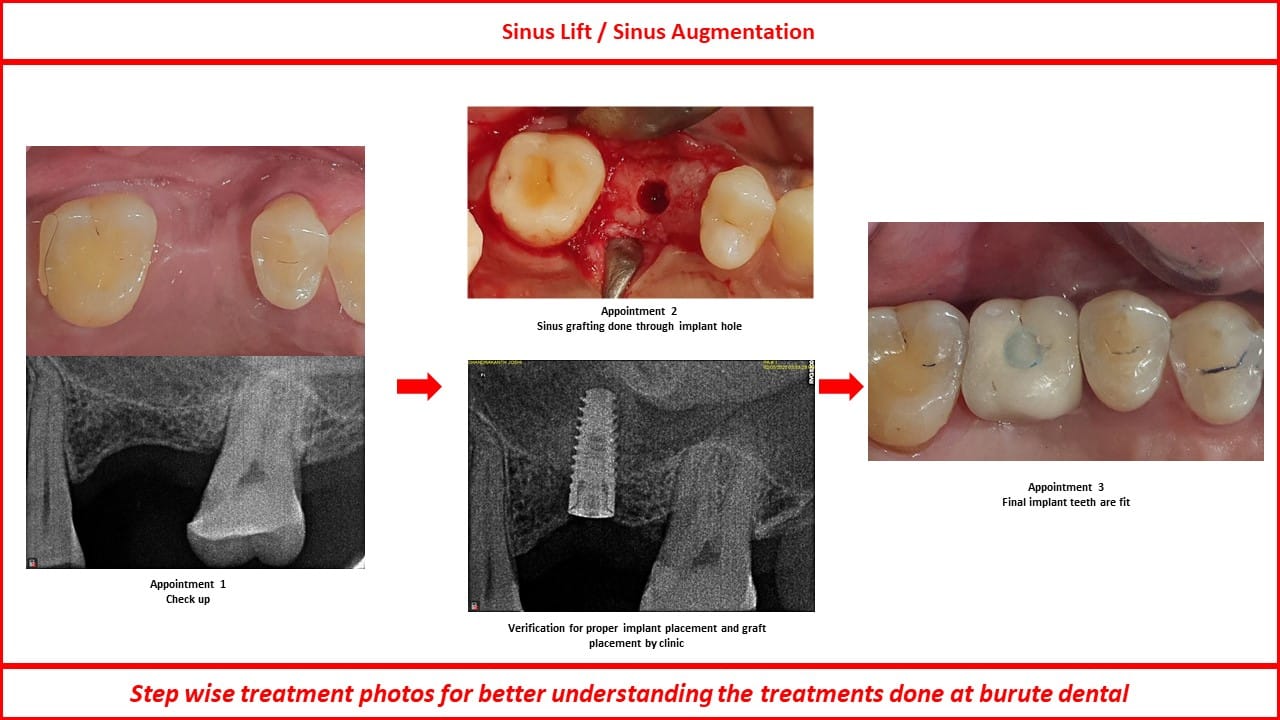
Sinus Lift / Sinus Augmentation

Sometimes the available jaw bone is not in the ideal position or there is severe bone loss. In such cases, placing a conventional straight implant may not be possible without extensive bone grafting. 

Angulated or customised implant solutions can be used in selected cases to make use of the available bone. 

These cases require detailed planning because the implant position, angulation, prosthesis and biting forces all have to be considered together. 

At Burute Dental, we use clinical examination and CBCT to study the available bone and plan a customised implant solution according to the individual patient’s anatomy. 

Slide21
Services 62

Sinus grafting + implant charges as applicable
Final quote after CBCT and clinical assessment

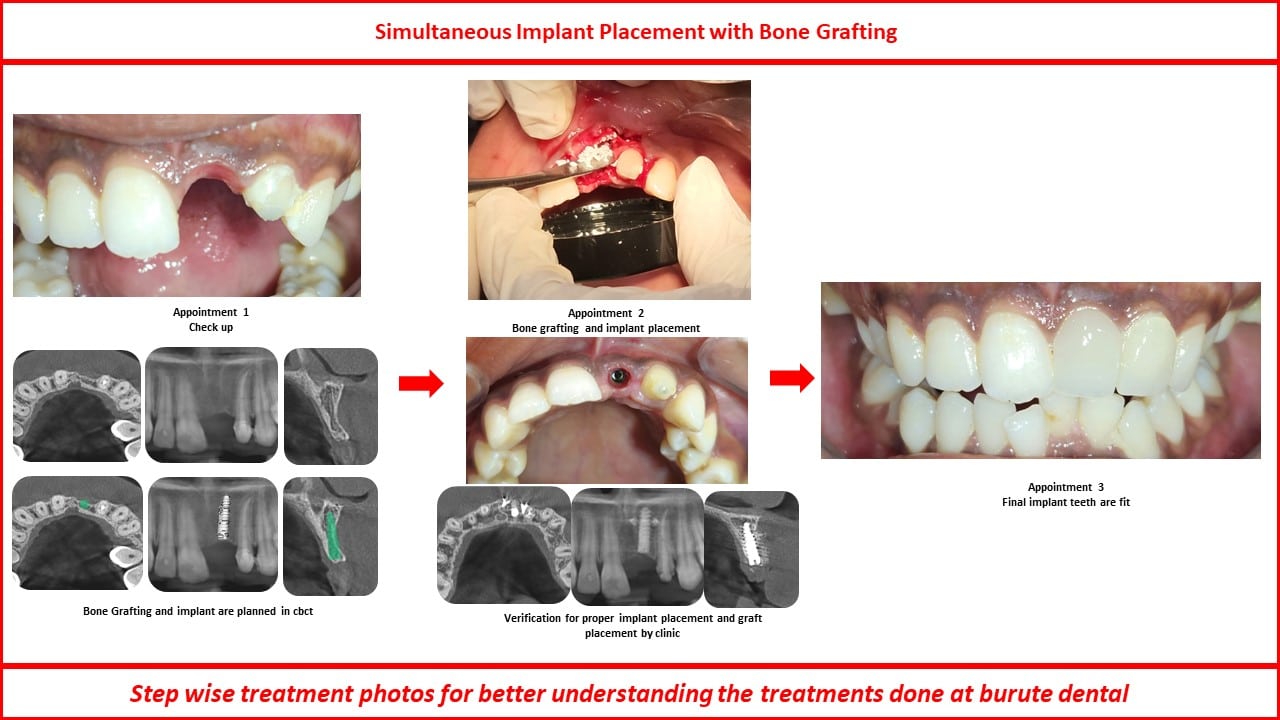
Simultaneous Implant Placement with Bone Grafting

In some cases there is bone loss around the area where the dental implant has to be placed. If the remaining bone is adequate and the defect is suitable, implant placement and bone grafting can be done during the same surgical procedure.

This can reduce the number of surgical procedures and treatment time in selected cases.

However, simultaneous implant placement with bone grafting is not possible in every case. The amount and quality of remaining bone has to be properly assessed before deciding the treatment.

At Burute Dental, we assess the area clinically and with CBCT and decide whether simultaneous implant placement and bone grafting is suitable for the patient.

Slide22
Services 63

Implant + grafting procedure charges
Final quote after CBCT and site assessment

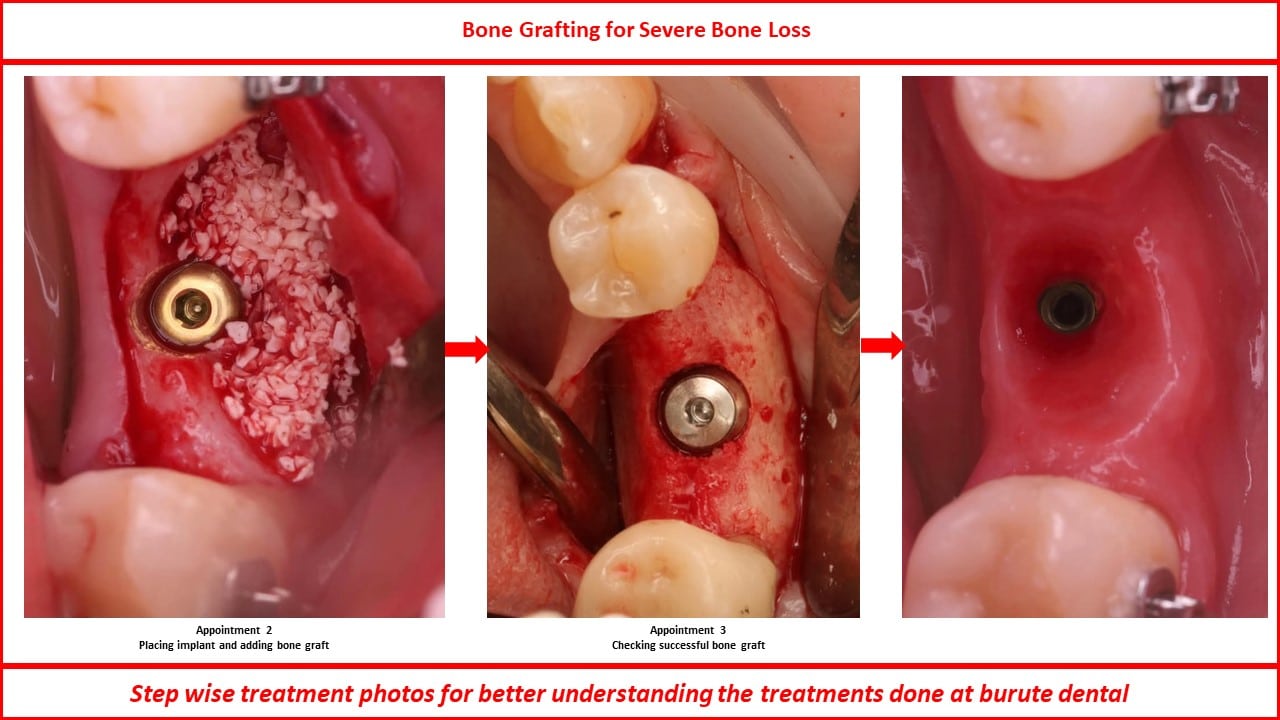
Bone Grafting for Severe Bone Loss

When there is severe loss of jaw bone, there may not be enough bone available to place a dental implant.

Bone grafting is a technique sensitive procedure and severe bone loss requires proper planning, good surgical skills and adequate quantity and quality of graft.

The type of grafting procedure depends on the location and amount of bone loss. In some cases, bone grafting has to be done first and the implant is placed after the bone has healed.

At Burute Dental, we assess the bone with X-rays and CBCT and plan the grafting procedure according to the exact bone requirement. Before and after X-rays and CBCT are used to evaluate the result of treatment.

Slide23
Services 64

Customized bone reconstruction package
Final quote after CBCT and surgical planning

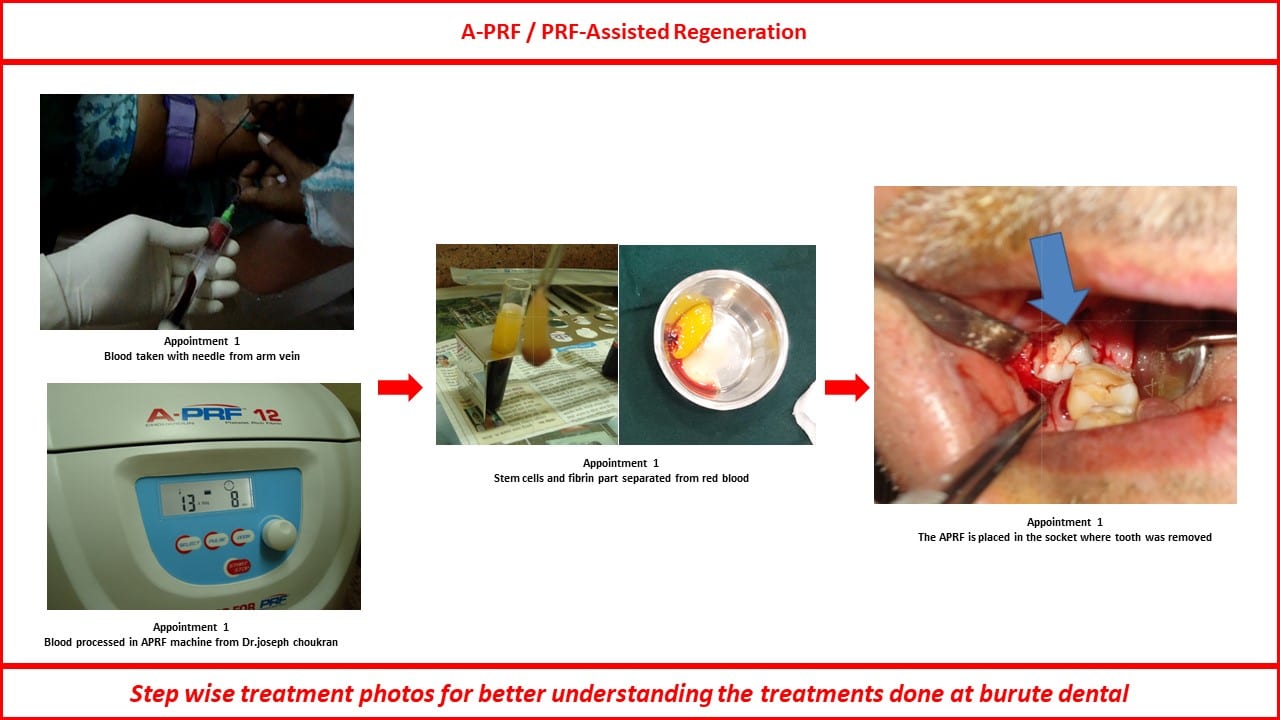
A-PRF / PRF-Assisted Regeneration

PRF is a technique where a small amount of patient’s own blood is used to prepare platelet rich fibrin.

PRF contains platelets and growth factors which can support healing and regeneration of the treated area.

PRF can be used along with bone grafting and other surgical procedures to support soft tissue and bone healing.

At Burute Dental, PRF is used wherever it is clinically indicated as a part of the treatment protocol. The procedure is done using the patient’s own blood and is planned according to the surgical requirement.

Slide24
Services 65

PRF / A-PRF charges as an adjunct
Final quote with the associated surgical procedure

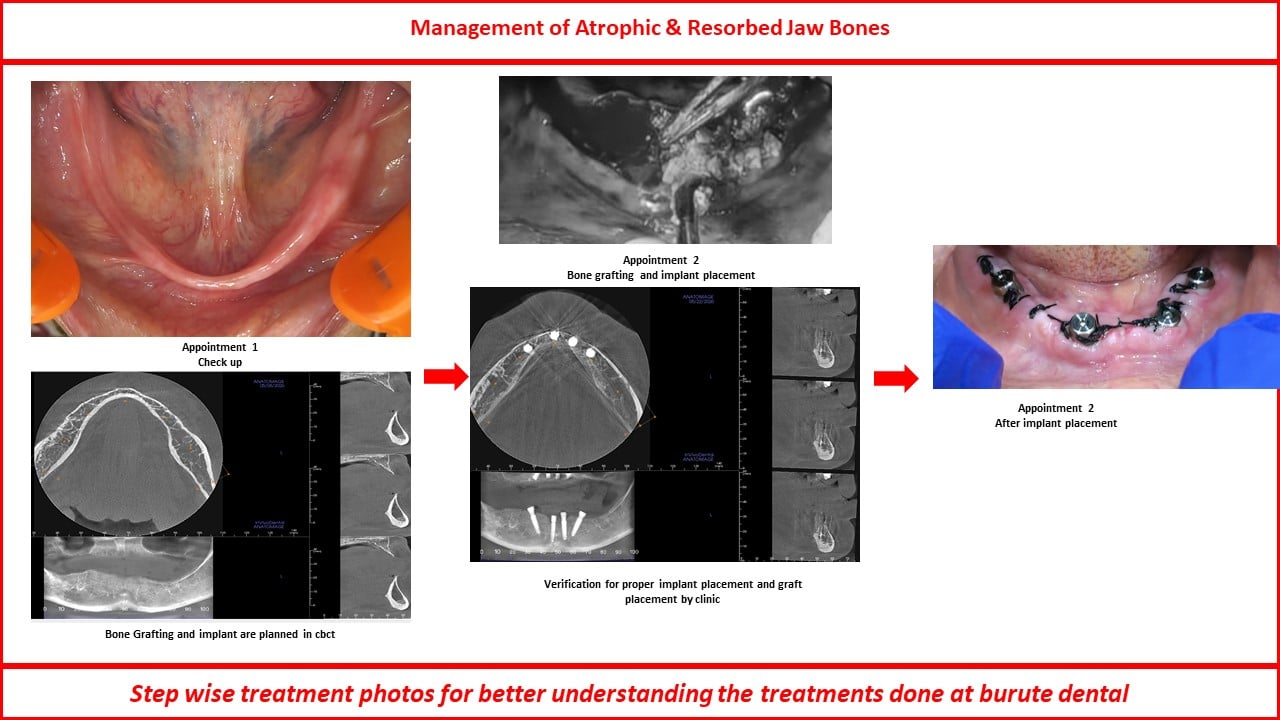
Management of Atrophic & Resorbed Jaw Bones

When teeth are missing for a long time, the jaw bone gradually becomes thin and short. This condition is called atrophic jaw bone.

In severe bone loss, there may not be enough bone to place a normal dental implant. In such cases, simply placing an implant may not give a predictable result.

The bone has to be properly assessed and a suitable bone augmentation procedure may be required. Depending on the amount and direction of bone loss, different techniques can be used.

At Burute Dental, we assess the bone with clinical examination, X-rays and CBCT and plan the most suitable solution according to the patient’s available bone and implant requirement.

Slide25
Services 66

Customized reconstructive treatment
Final quote after CBCT and comprehensive planning

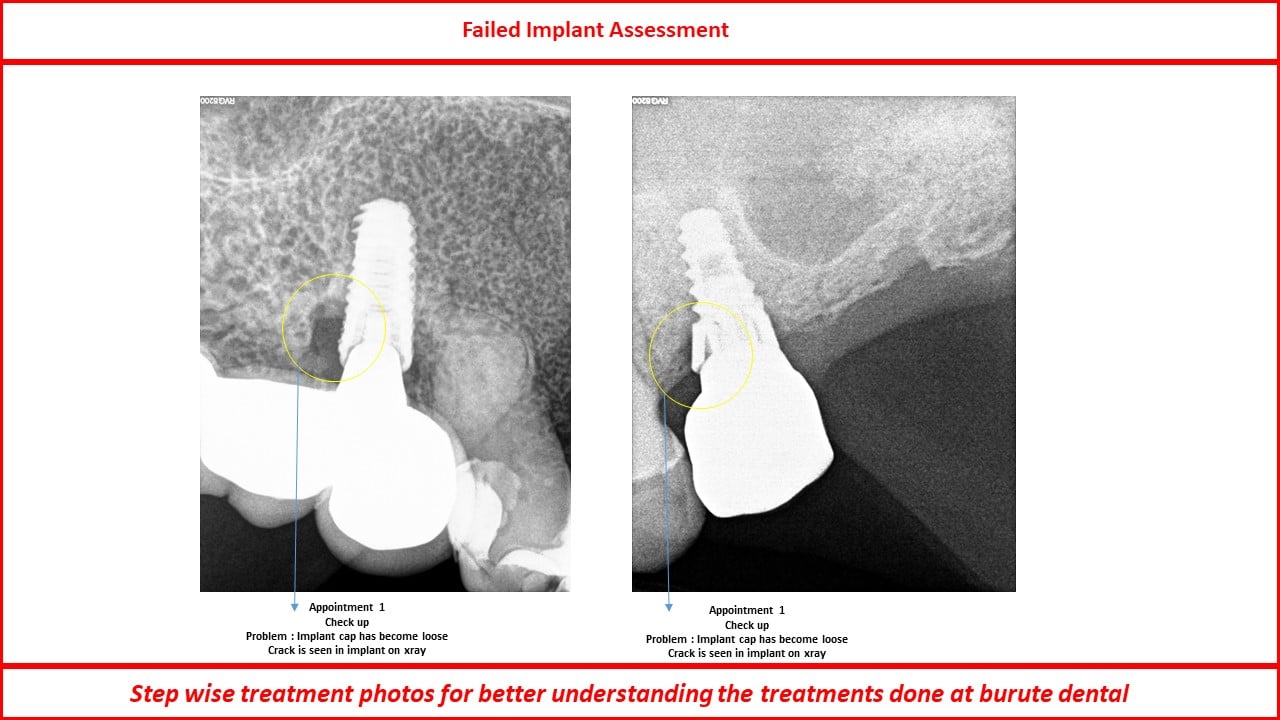
Failed Implant Assessment

Dental implant can fail due to many reasons. Sometimes the implant may become loose, infected or there may be loss of bone around the implant. 

Reasons for failed implant are – infection around implant, poor quality or quantity of bone, improper implant position, excessive biting force, poor oral hygiene, smoking, medical conditions etc. 

Failed implant needs proper assessment before deciding the next treatment. The failed implant may have to be removed and the infection and damaged tissue has to be cleaned. 

At Burute Dental, we assess the failed implant with clinical examination, X-rays and CBCT to understand the exact reason for failure. Based on the amount of remaining bone and condition of the area, we plan the next stage of treatment scientifically. 

Slide26
Services 67

Consultation + imaging charges as applicable
Final treatment quote after diagnosis

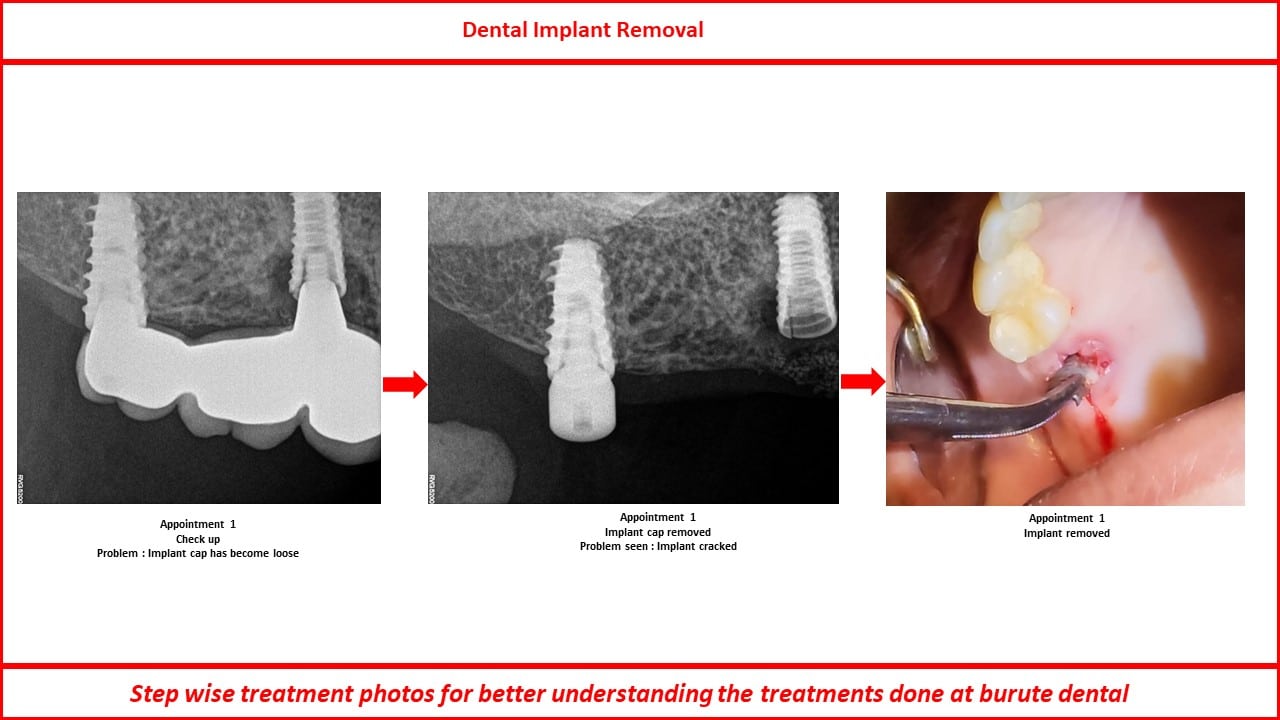
Dental Implant Removal

Some implant-related conditions, such as plaque or food accumulation around an implant, and certain minor infections, can often be managed with appropriate cleaning, maintenance, and treatment. 

However, when an implant is fractured, severely damaged, or has become non-restorable, removal may be necessary. Implant fracture can occur due to factors such as excessive functional forces, repeated mechanical stress, parafunctional habits such as bruxism, or design and material-related factors. 

In some cases, patients may also place excessive force on an implant by biting on very hard foods or objects, potentially contributing to mechanical complications. 

Dr. Mrunal Burute has extensive clinical experience in the removal of fractured, failed, and mechanically compromised dental implants, including broken Osstem implants. 

The objective during implant removal is to remove the compromised implant while preserving as much of the surrounding healthy bone and soft tissue as possible. Careful planning and appropriate surgical techniques can help minimise unnecessary trauma to the adjacent bone and tissues. 

Once the implant has been removed, the site can be evaluated to determine whether bone regeneration, healing, or future implant replacement is appropriate. 

Slide27
Services 68

Removal procedure charges
Final quote after examination and imaging

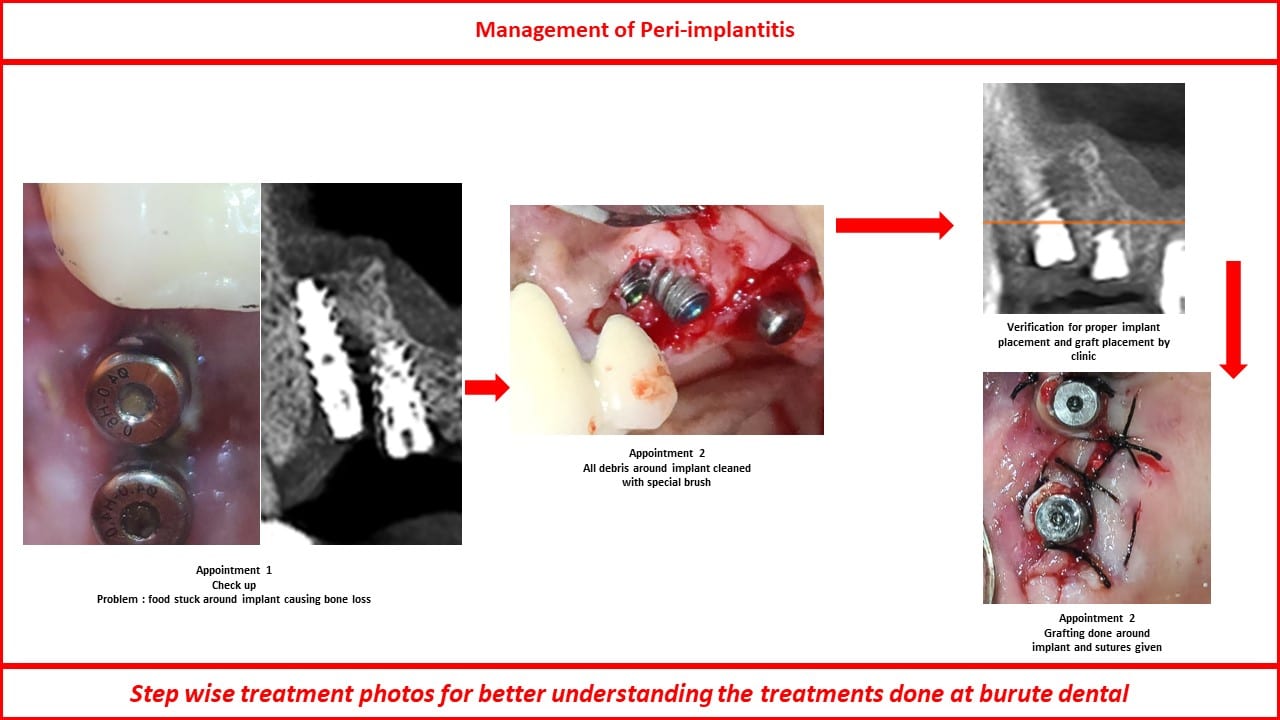
Management of Peri-implantitis

Peri-implantitis is an inflammatory condition around a dental implant that is commonly associated with inadequate plaque control and difficulty maintaining proper oral hygiene around the implant-supported prosthesis. 

When plaque and bacterial deposits accumulate around the implant collar and are not adequately removed, inflammation can progress deeper around the implant and may result in loss of the supporting bone. 

Dr. Mrunal Burute focuses on both treatment and prevention of peri-implantitis. Implant-supported teeth are designed with appropriate contours and, wherever possible, easily accessible areas for cleaning, making it easier for patients to maintain oral hygiene around their implants. 

Patients are also given detailed instructions and training on daily implant hygiene and maintenance. 

When peri-implantitis develops, the implant area is thoroughly assessed and the accumulated deposits and inflamed or infected tissues are carefully cleaned. Where clinically appropriate, bone regenerative procedures may be performed around the existing implant to address the bone defect. 

When the existing implant is stable and suitable for preservation, treating the peri-implant disease and regenerating the lost bone may help avoid unnecessary removal and replacement of the implant, potentially reducing the need for additional implant surgery and associated recovery time. 

Regular professional maintenance and good daily oral hygiene are essential for the long-term health of dental implants. 

Slide28
Services 69

Treatment based on severity and procedure required
Final quote after clinical and CBCT assessment

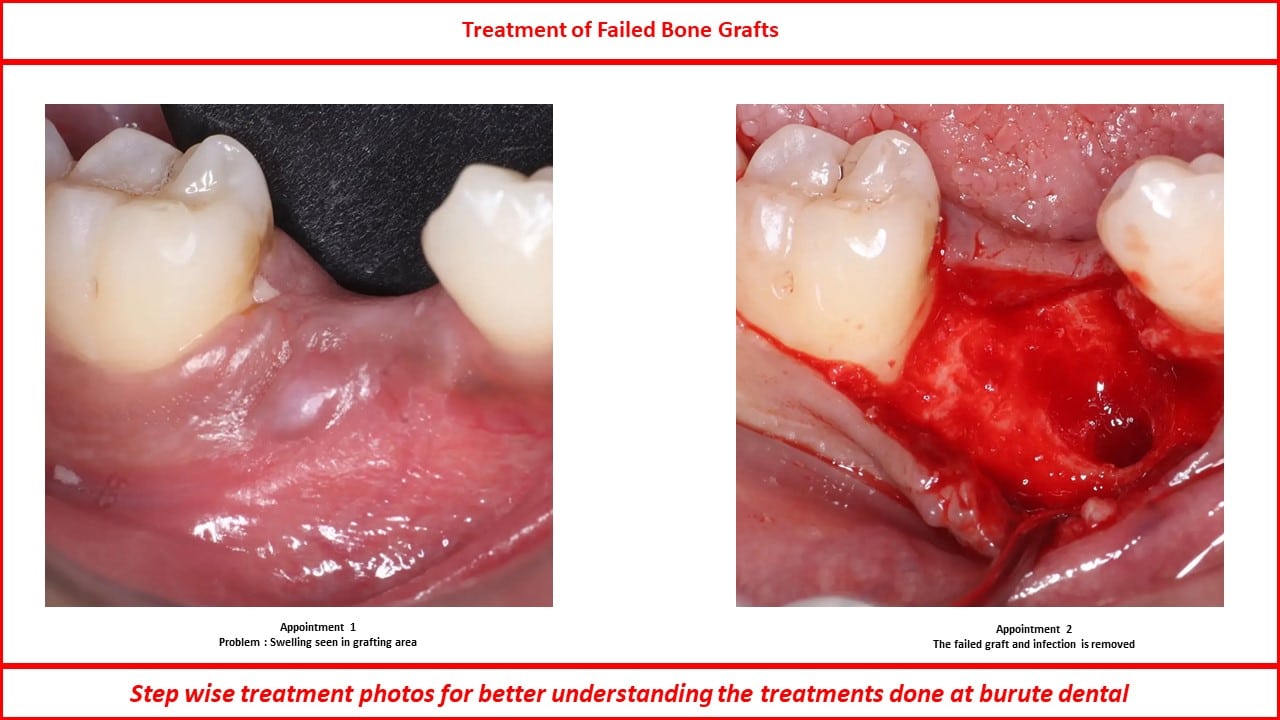
Treatment of Failed Bone Grafts

Bone grafting is a highly technique-sensitive surgical procedure that requires sound clinical knowledge, experience, careful case selection, and good surgical skills.

  • Bone grafting may fail for several reasons, including:
  • Use of an inappropriate or poor-quality graft material
  • Inadequate quantity or volume of graft material
  • Performing grafting in patients with poorly controlled blood sugar levels
  • Improper surgical technique or handling of the graft
  • Inadequate protection or healing of the grafted site
  • Infection or other patient-related healing factors

A failed bone graft may become infected or fail to integrate with the surrounding bone. In such situations, the failed graft material and infected tissue may need to be carefully removed and the site thoroughly debrided before considering a new grafting procedure.

Depending on the clinical situation, adequate healing may also be required before attempting the next stage of treatment.

At Burute Dental, we follow a systematic and evidence-based protocol for bone grafting procedures. Patient-specific clinical and radiographic assessment is carried out before treatment, and healing is monitored following the procedure.

We also maintain clinical photographs and radiographic records, including X-rays and CBCT scans where indicated, to document the treatment progress and assess the outcome.

Our aim is to ensure that bone grafting is performed with appropriate planning, surgical precision, and careful follow-up rather than treating it as a routine procedure.

Slide29
Services 70

Revision grafting / surgical charges based on the defect
Final quote after CBCT and assessment

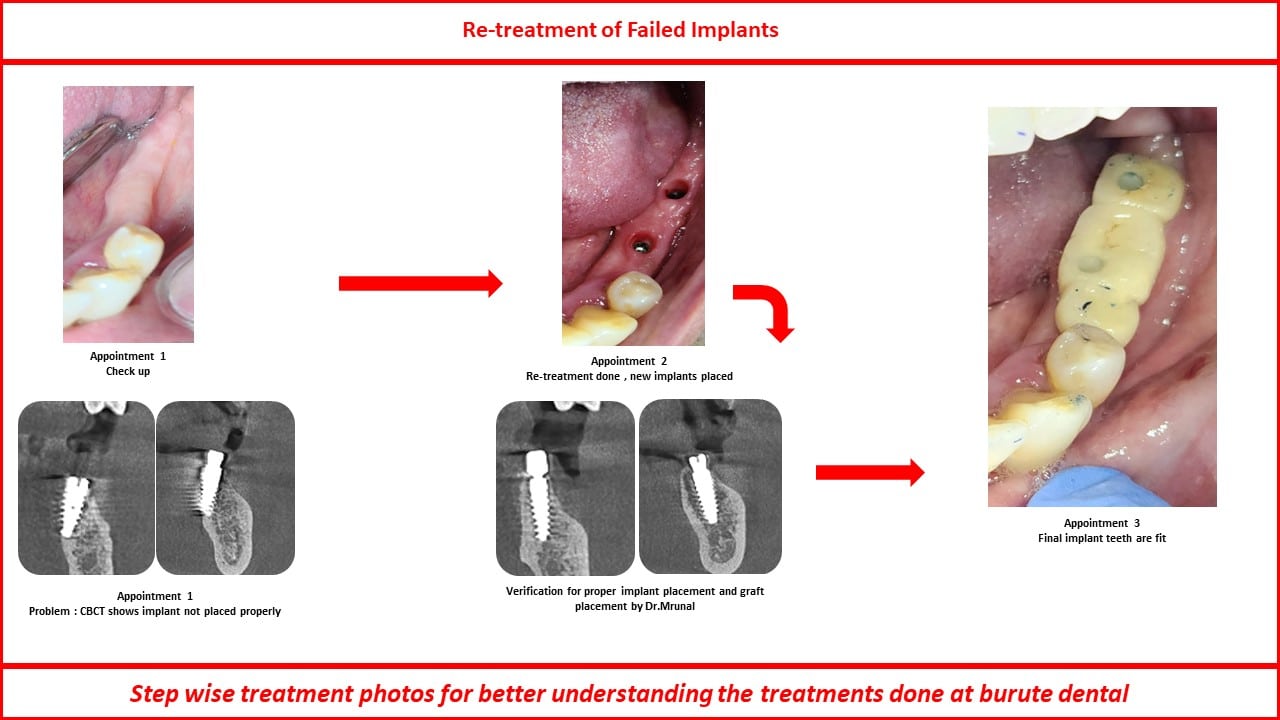
Re-treatment of Failed Implants

Patients who have previously received dental implants at another clinic may sometimes experience pain, infection, mobility, bone loss, prosthetic problems, or other complications. 

When such patients visit us for evaluation, the first step is a detailed clinical assessment along with a 3D CBCT scan, when indicated. This allows us to evaluate: 

– The three-dimensional position of the implant 

– The amount and quality of bone surrounding the implant 

– Bone loss or infection around the implant 

– The relationship of the implant to important anatomical structures 

– The prosthetic design and occlusal considerations 

– The overall condition of the implant and surrounding tissues 

Failed or compromised implants can present with different underlying causes. 

In some cases, an implant may have been positioned in a manner that results in inadequate bone support on one side. Other cases may involve infection and progressive bone loss around the implant, implant mobility, or prosthetic complications. 

Implant damage can also occur in certain situations due to excessive mechanical forces, inappropriate implant selection or design, excessive insertion torque, or surgical factors such as inadequate thermal control during osteotomy preparation. 

Because the cause of failure can vary from one patient to another, simply replacing the implant without identifying the underlying problem may not provide a predictable solution. 

Dr. Madhura Burute follows a systematic protocol for evaluating failed or compromised dental implants. 

The treatment plan is based on identifying the type, cause, and extent of implant failure, followed by determining whether the implant can be maintained, treated, or requires removal and replacement. 

Depending on the individual case, management may involve treatment of infection, correction of prosthetic factors, implant removal, bone regeneration, or carefully planned replacement of the implant. 

We have successfully managed multiple complex implant retreatment cases, helping patients regain function, aesthetics, and confidence in their treatment. 

The goal is not simply to replace a failed implant, but to identify why the original treatment failed and address the underlying problem before planning the next stage of treatment. 

Slide30
Services 71

Customized re-treatment package
Final quote after CBCT and complete evaluation

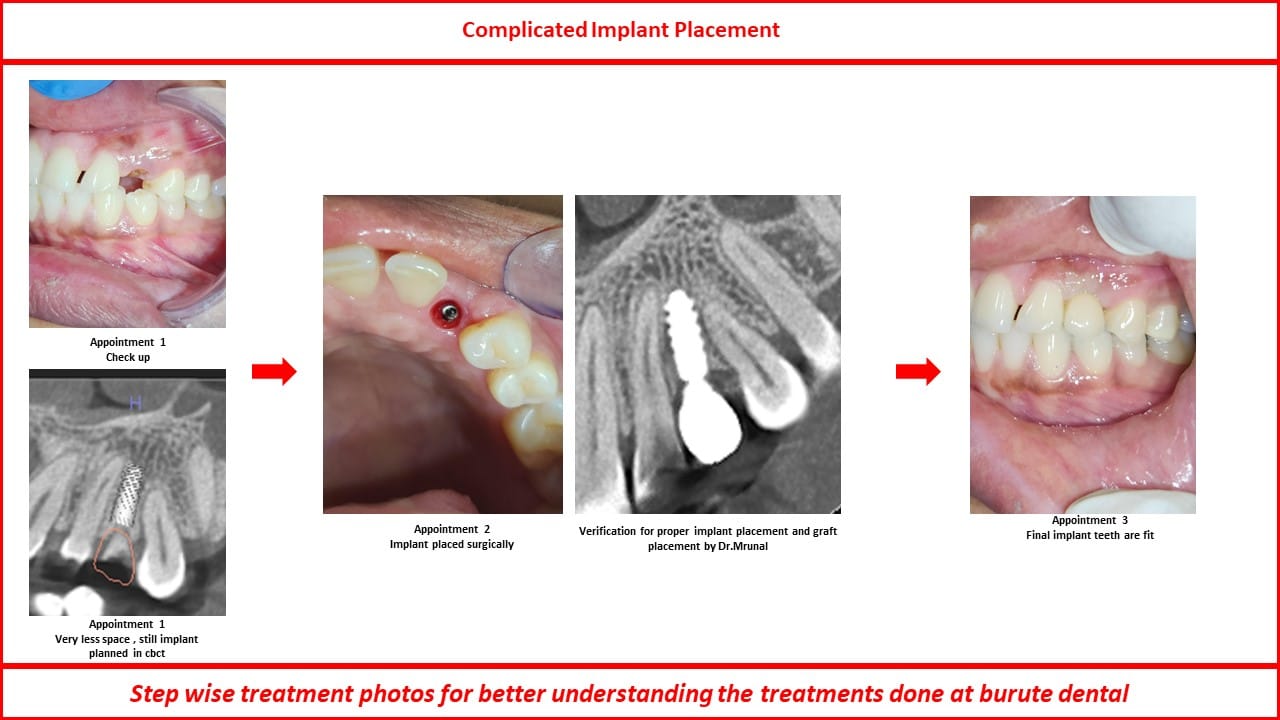
Complicated Implant Placement

When a tooth has been missing for a long period, the adjacent teeth may gradually drift or tilt into the empty space. As the visible crowns move closer together, the roots may also become convergent, leaving very limited space for implant placement. 

When the adjacent teeth and their roots have moved into the missing-tooth space, there may be very little room available for safely positioning an implant. 

The implant must be placed with sufficient clearance from the adjacent tooth roots while also achieving an appropriate position for the final crown or prosthesis. 

In severely restricted spaces, even a small deviation in implant positioning can affect the relationship between the implant, adjacent roots, and final restoration. 

Dr. Mrunal Burute has extensive experience in managing implant placement in anatomically restricted and highly compact spaces. 

Each case is carefully evaluated using 3D CBCT imaging and digital implant planning to identify the available space and determine the safest and most prosthetically appropriate implant position. 

In cases where the available space permits only a very narrow margin for error, precise planning and controlled surgical execution become particularly important. 

Dr. Mrunal Burute has treated numerous complex cases involving severely restricted implant spaces, with examples of such cases available for patients to view at the clinic. 

The goal is to achieve precise implant positioning while protecting adjacent teeth and their roots and ensuring an appropriate foundation for the final prosthetic restoration. 

Slide31
Services 72

Customized implant procedure charges
Final quote after CBCT and surgical planning

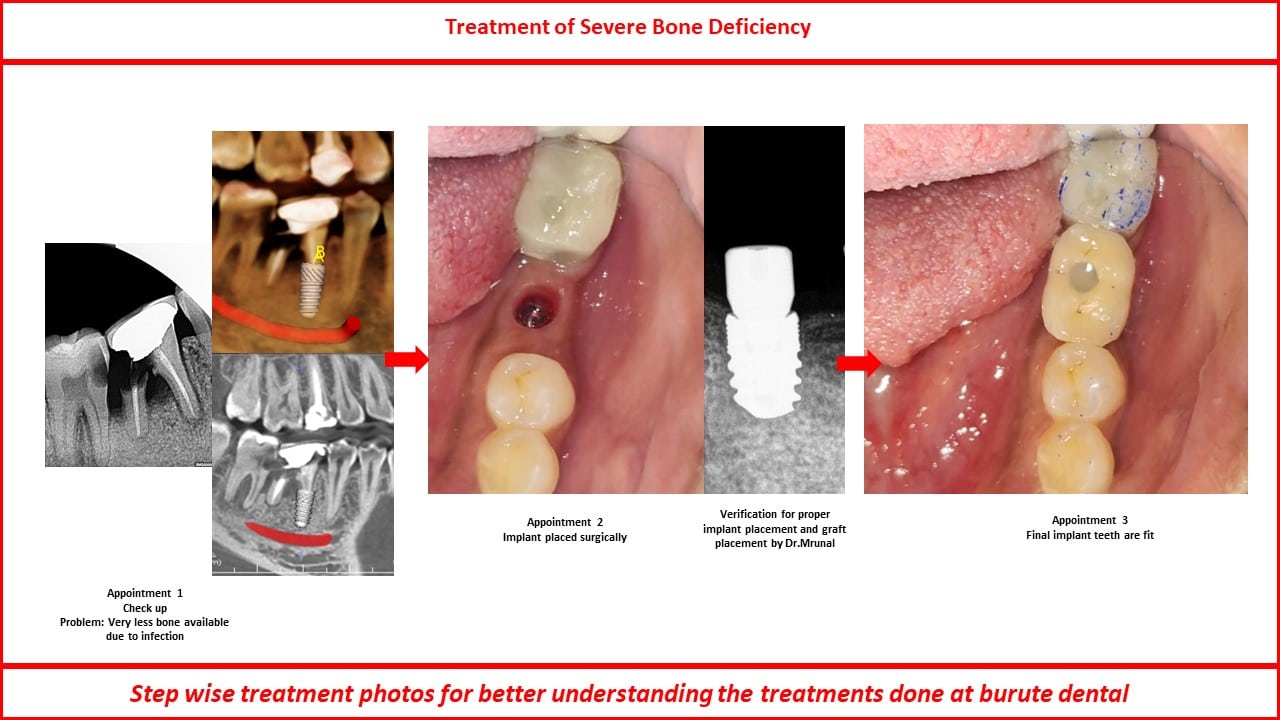
Treatment of Severe Bone Deficiency

Patients with long-standing dental infections and severely compromised teeth can gradually lose the bone supporting those teeth. When significant bone loss occurs, both the height and width of the available bone may be reduced. 

Once substantial bone has been lost, placing an implant becomes more challenging because there may not be sufficient bone volume to provide adequate support and stability around the implant. 

Severe bone deficiency can present several challenges: 

– Reduced bone height, limiting the available vertical space for implant placement. 

– Reduced bone width, making it difficult to accommodate a conventional-diameter implant. 

– Previous or chronic infection, which must be thoroughly controlled and eliminated before implant placement. 

– Compromised bone quality, which can affect implant stability and treatment planning. 

– In medically compromised patients, including those with diabetes, bone augmentation procedures may require additional precautions and careful case selection. 

Dr. Mrunal Burute has extensive experience in managing complex implant cases with severely deficient bone. 

Depending on the patient’s individual anatomy, he may use short and wide implants or narrow and long implants, along with carefully selected prosthetic components, to make optimal use of the available bone. 

The implant dimensions, position, and prosthetic design are selected according to the available bone, anatomical limitations, functional requirements, and final restoration. 

This approach can help manage complex cases while, where clinically appropriate, reducing the need for extensive bone augmentation procedures. 

The objective is to achieve a stable, functional, and long-lasting implant-supported restoration, with implant treatment planned according to the patient’s individual anatomical and clinical requirements. 

Slide32
Services 73

Customized bone reconstruction + implant plan
Final quote after CBCT and complete assessment

Full-Mouth Implant Failure Rehabilitation

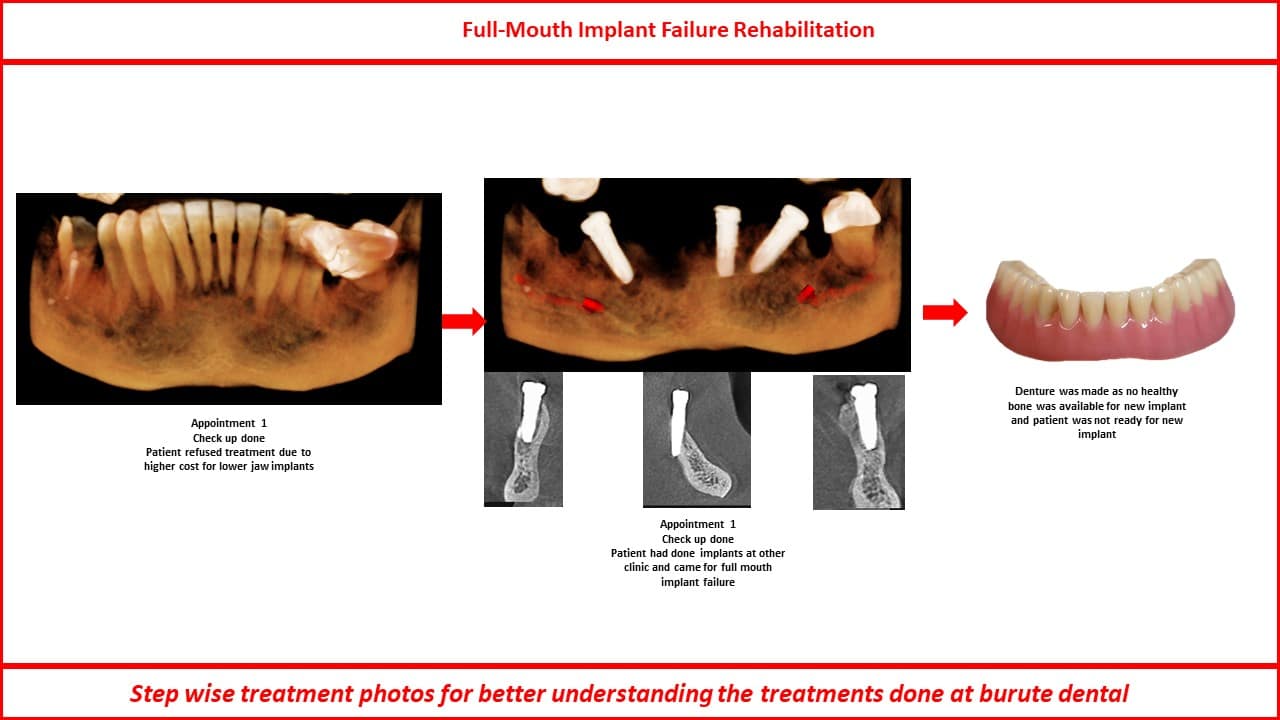
A young, medically healthy patient initially visited Burute Dental seeking replacement of the lower teeth with a fixed, full-arch implant-supported prosthesis. The patient had favourable bone availability and was considered a suitable candidate for a planned six-implant full-arch rehabilitation. 

However, after comparing treatment costs, the patient decided to undergo implant treatment at another dental centre. 

The patient subsequently underwent extraction of the lower teeth followed by implant placement at another clinic. Following treatment, she experienced significant and persistent pain. 

When she later presented to Burute Dental for reassessment, radiographic evaluation showed that several of the remaining implants had unfavourable angulation and positioning, with some appearing to extend beyond the available bony housing. Some implants had already been removed elsewhere because of complications. 

The CBCT assessment also revealed severely compromised remaining bone. The patient had undergone extensive bone reduction procedures during the previous treatment, leaving insufficient healthy bone in suitable positions for predictable placement of new implants. 

The remaining implants were carefully evaluated for their position, bone support, prosthetic suitability and long-term prognosis. Because of their compromised positioning and/or inadequate prosthetic suitability, they could not be predictably incorporated into a new fixed implant-supported rehabilitation. 

An implant-retained overdenture was also considered but was not a suitable option because the existing implants did not provide a predictable foundation for such a prosthesis. 

At this stage, placing additional implants would have required further complex treatment and bone reconstruction. Moreover, after her previous difficult treatment experience, the patient was not comfortable undergoing another implant procedure. 

After discussing the available options, the patient chose a conventional removable lower denture instead. 

At Burute Dental, an accurately fabricated, well-fitting removable denture was provided to restore her ability to chew and improve oral function without subjecting her to another surgical implant procedure. 

This case demonstrates that implant treatment is not simply about placing implants—it requires careful three-dimensional planning, appropriate implant positioning, preservation of bone and prosthetically driven rehabilitation. 

When implant treatment is compromised, early clinical and CBCT-based assessment can be important in determining whether existing implants can be retained, whether they can be incorporated into a prosthesis, or whether an alternative rehabilitation should be considered. 

In this case, the most appropriate treatment ultimately became a well-fitting removable denture rather than attempting another implant procedure. The treatment plan was therefore tailored to the patient’s remaining anatomy, clinical situation and personal comfort with further surgery. 

Slide33
Services 74

Customized full-mouth rehabilitation package
Final quote after CBCT and complete treatment planning

Second-Opinion Implant Consultation

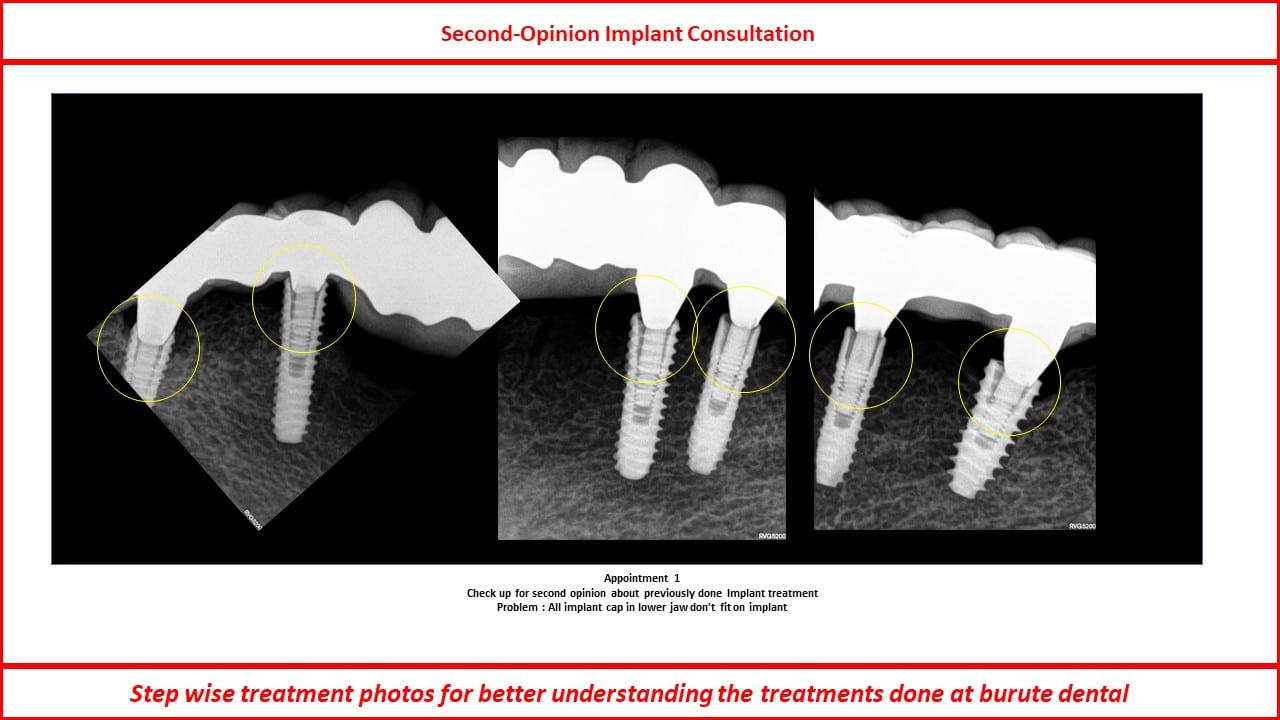
A patient visited Burute Dental for a second opinion after experiencing persistent pain associated with implant-supported teeth. 

The implant teeth had been placed approximately 2 months earlier by another dentist. The patient told us that there was no pain following implant placement. However, discomfort began after the final implant crowns/prosthesis were delivered. Despite the persistent symptoms, the patient was advised that the pain would eventually resolve on its own. As the discomfort continued and began interfering with eating, the patient sought a second opinion with Burute dental implant centre. 

On clinical examination, the tissues and implant sites appeared satisfactory, with no obvious clinical signs explaining the patient’s symptoms. 

A detailed radiographic evaluation was therefore carried out. The radiographs, together with the clinical findings, raised concerns regarding the fit of the implant-supported prosthesis. 

The three implants were connected by a splinted prosthesis that did not appear to be passively fitting. A non-passive implant prosthesis can potentially introduce unwanted forces and biomechanical stress into the implant–prosthesis complex. Such discrepancies may be associated with inaccuracies during impression making, implant-position recording, laboratory procedures, or prosthesis fabrication. 

In this case, the prosthetic fit and occlusion were considered important possible contributors to the patient’s persistent discomfort. 

Dr. Madhura Burute reassessed the implant prosthesis and took a new, carefully controlled impression/implant-level record to improve the accuracy of the working model and subsequent prosthesis fabrication. 

A new implant-supported prosthesis was then fabricated with the aim of achieving a more accurate and passive fit, minimising unnecessary mechanical stress on the underlying implants. 

The occlusion was also carefully evaluated and adjusted to help distribute functional forces appropriately and protect the implant-supported restoration during chewing. 

This case highlights why persistent pain after implant prosthesis delivery should not simply be ignored or assumed to resolve spontaneously. Even when the mouth appears clinically normal, careful evaluation of the implant prosthesis, radiographs, fit and occlusion can help identify prosthetic or biomechanical factors that may be contributing to discomfort. 

At Burute Dental, implant complications and second-opinion cases are evaluated by considering both the biological and prosthetic aspects of implant treatment, rather than looking at the implant alone. 

Slide34
Services 75

Not applicable

Consultation + CBCT review as applicable
Treatment quote provided separately if required

3D CBCT-Based Implant Planning

Conventionally, implant planning was often performed using OPG (panoramic radiographs) or IOPA (intraoral periapical radiographs). These two-dimensional images provided limited information about the available bone and were primarily used to assess the apparent height of bone and the approximate relationship of the implant site to critical anatomical structures such as the inferior alveolar nerve or maxillary sinus. 

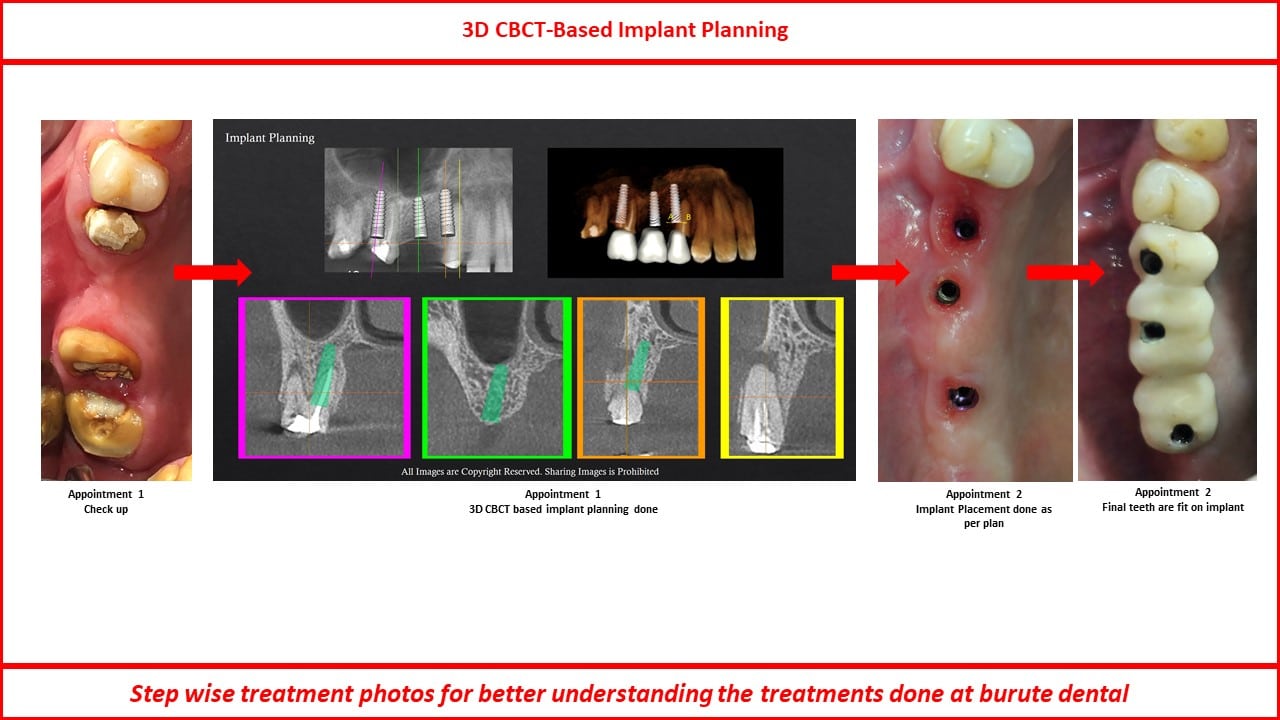
Modern 3D CBCT technology provides a much more comprehensive assessment of the implant site. Unlike conventional two-dimensional radiographs, CBCT allows the clinician to evaluate the jawbone in multiple planes and assess parameters such as bone height, width, thickness, angulation, and the relationship with important anatomical structures. 

This is particularly valuable when the available bone is narrow, irregular, or anatomically challenging. 

Dr. Mrunal Burute uses dedicated 3D CBCT-based implant-planning software to evaluate the patient’s jawbone three-dimensionally. 

The implant can be digitally positioned according to the available bone and prosthetic requirements, with the objective of placing it within the centre of the available bone while maintaining an appropriate relationship with surrounding anatomical structures. 

This allows implant treatment to be planned based on the patient’s actual three-dimensional anatomy, rather than relying solely on the information available from a two-dimensional OPG or IOPA. 

The result is a more prosthetically driven, anatomically informed, and predictable approach to implant planning. 

Slide35
Services 76

CBCT + planning charges as applicable
Treatment quote provided after final plan

Digital Implant Planning

Traditionally, dental implant planning relied primarily on two-dimensional radiographs such as OPG (panoramic X-rays) and IOPA (intraoral periapical radiographs). While these images provide useful diagnostic information, they offer limited insight into the three-dimensional shape and volume of the jawbone. 

The apparent bone height and proximity of important anatomical structures, such as the inferior alveolar nerve and maxillary sinus, could be assessed, but the actual bone width, thickness and angulation could not be evaluated comprehensively. 

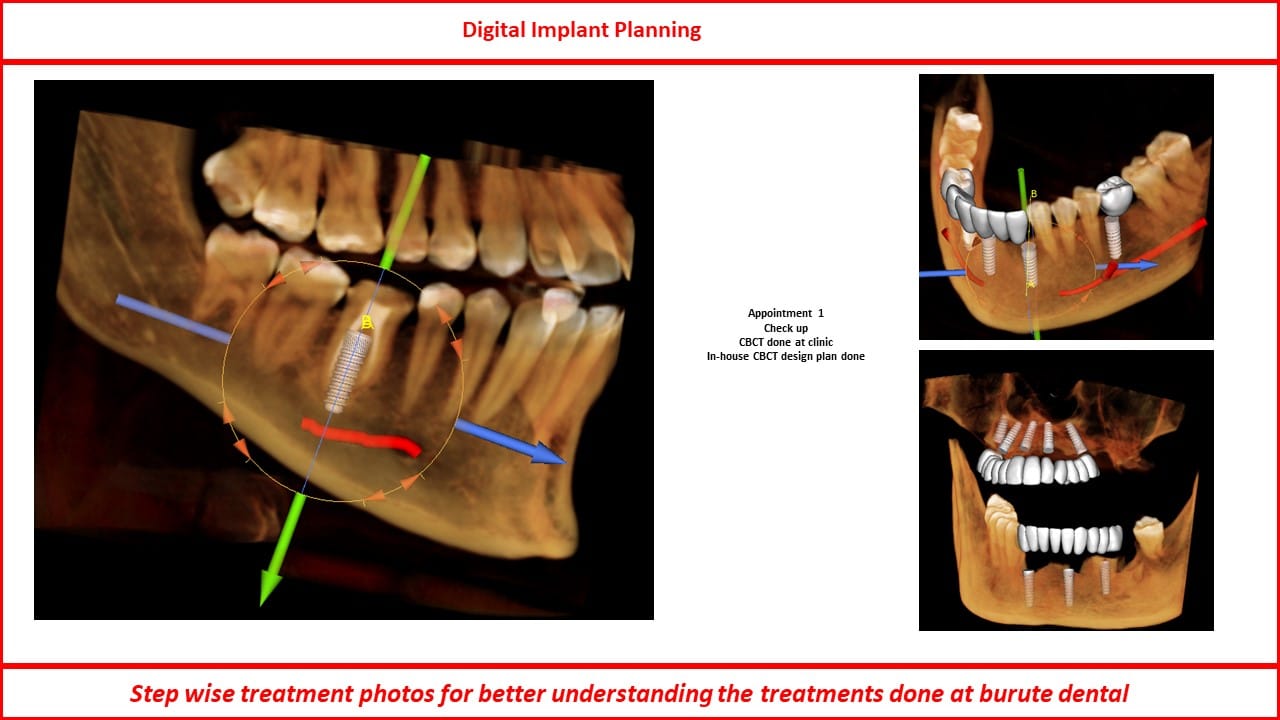
With modern 3D CBCT imaging, implant sites can be evaluated in three dimensions before treatment begins. The clinician can assess bone height, width, thickness and angulation, as well as precisely examine the relationship between the proposed implant site and surrounding anatomical structures. 

This detailed assessment becomes particularly important in areas where the bone is narrow, uneven, resorbed or close to vital anatomical structures. 

Dr. Mrunal Burute uses advanced CBCT-based implant planning software to digitally evaluate each implant site according to the patient’s individual anatomy. 

The proposed implant can be virtually positioned within the available bone while considering both anatomical safety and the final prosthetic requirements. This helps determine an appropriate implant position, angulation and depth before the surgical procedure. 

By combining 3D imaging with prosthetically driven digital planning, implant treatment can be designed around the patient’s actual anatomy rather than relying only on information obtained from conventional two-dimensional radiographs. 

The objective is to achieve implant placement that is anatomically informed, prosthetically driven and carefully planned, helping make the overall treatment more predictable and personalised for each patient. 

Slide36
Services 77

Digital planning charges as applicable
Final treatment quote after planning

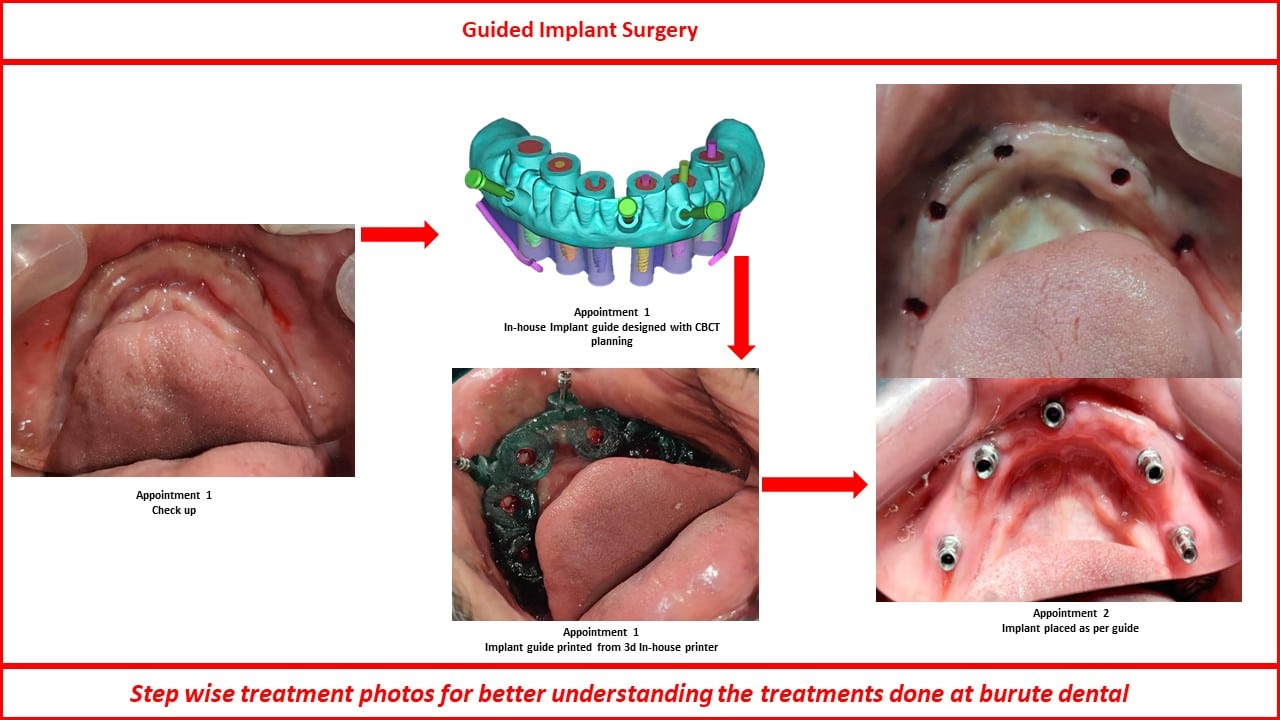
Guided Implant Surgery

In some patients, clinical and anatomical factors may make conventional implant surgery, involving extensive flap elevation, less desirable or unsuitable. 

A conventional approach with extensive flap reflection may not always be appropriate, particularly when the treatment requires a minimally invasive surgical approach and preservation of the surrounding soft and hard tissues is a priority. 

When clinically appropriate, a minimally invasive, flapless implant placement approach may be considered. 

In such cases, Dr. Mrunal Burute designs and manufactures customized surgical guides within his own clinic using biocompatible materials. This allows the guide design to be closely integrated with the patient’s CBCT-based treatment plan and the planned surgical procedure. 

By keeping the planning and guide-design process closely connected to the clinician performing the implant surgery, the surgical guide can be customized according to the actual clinical and anatomical requirements of the patient, rather than relying solely on an external laboratory or agency unfamiliar with the clinical aspects of implant placement. 

The objective is to achieve precise, minimally invasive implant placement while preserving available bone and soft tissue wherever clinically possible. 

Slide37
Services 78

Guide + implant procedure charges
Final quote after CBCT and digital planning

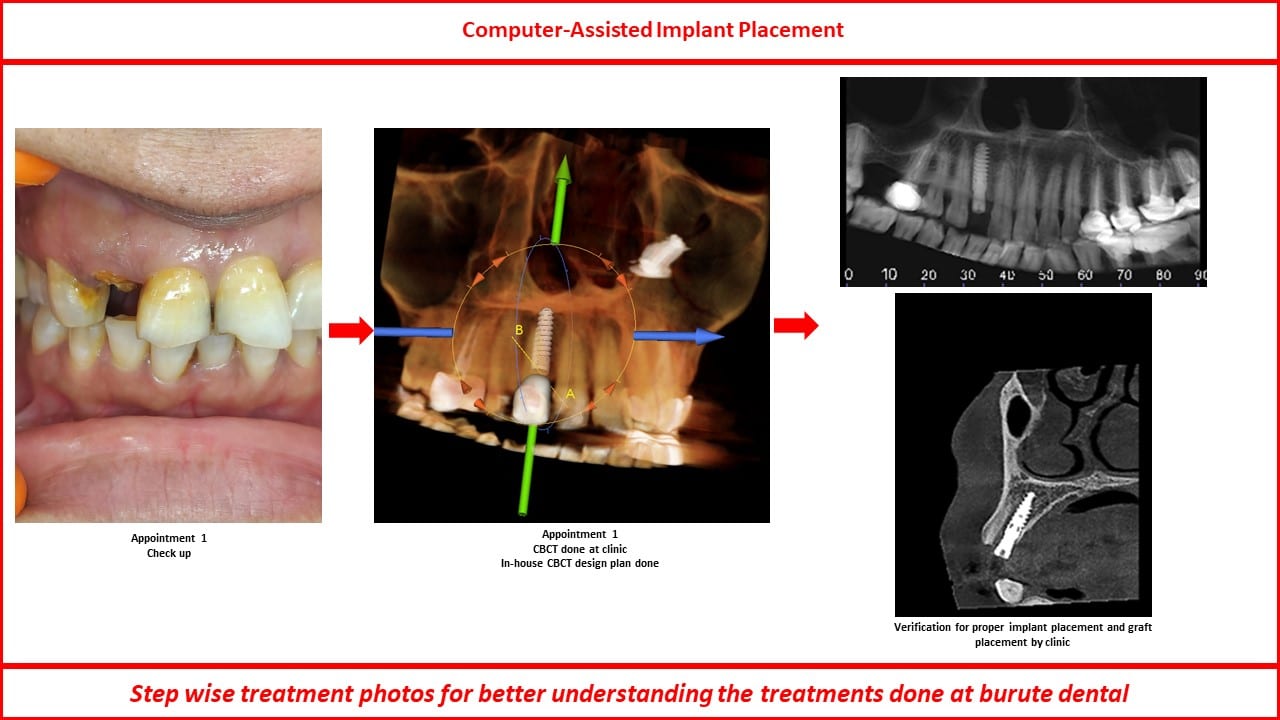
Computer-Assisted Implant Placement

Conventionally, the prosthetic design was created using wax-ups prepared by dental technicians. Although this approach remains useful, it can be subject to limitations in terms of precision, predictability, and communication between the clinical and laboratory stages. 

Today, computer-assisted technology has transformed implant dentistry by supporting prosthetic design, treatment planning, surgical execution, and post-treatment evaluation. 

At Burute Dental, we integrate multiple digital technologies into the treatment workflow: 

– Digital Smile Design software to plan and harmonize the appearance and position of the front teeth. 

– Implant planning software for precise three-dimensional implant positioning. 

– Surgical guide design software to create customized guides for computer-assisted implant placement. 

– DICOM viewers and digital imaging tools to evaluate the implant position and compare the planned and post-operative results. 

By integrating these technologies within our clinical workflow, Dr. Mrunal Burute maintains direct control over the digital planning process rather than relying on external institutions for critical software-based treatment planning. 

This integrated digital approach helps create a more coordinated workflow from diagnosis and prosthetic design to implant planning, surgical execution, and post-operative evaluation, with the goal of achieving greater precision and predictability in implant treatment. 

Slide38
Services 79

Computer-assisted procedure charges
Final quote after digital planning and CBCT

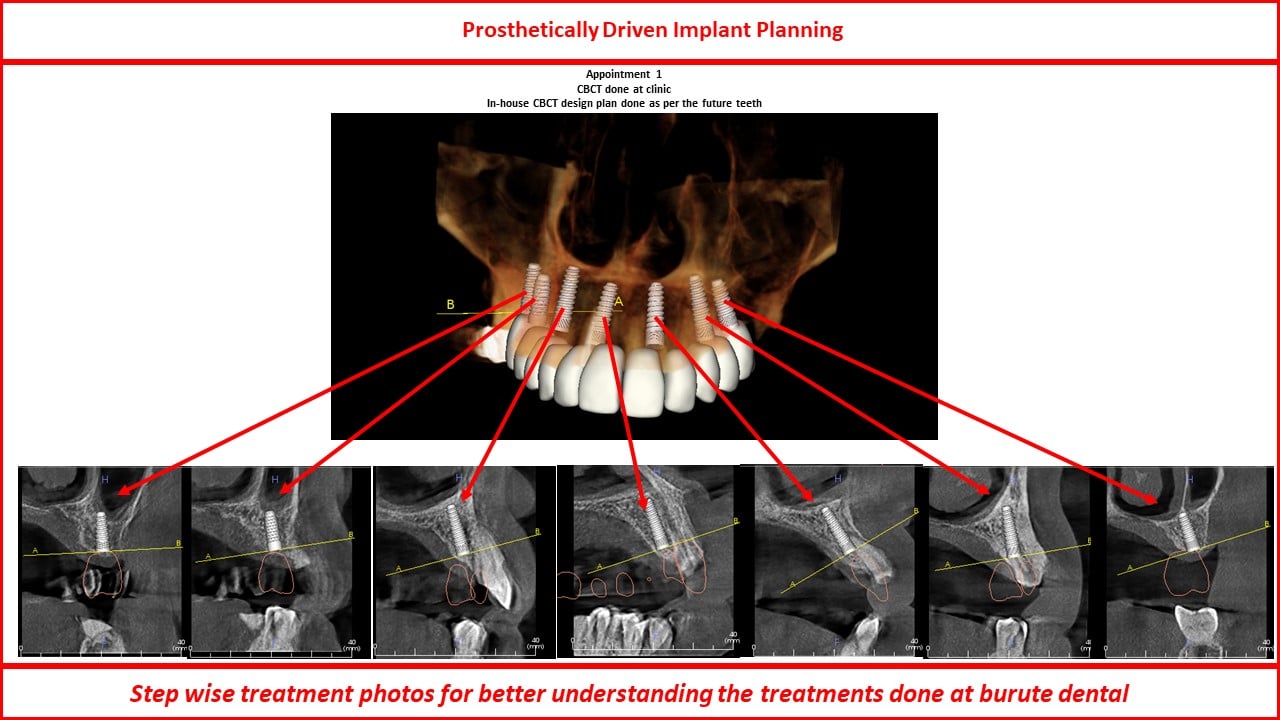
Prosthetically Driven Implant Planning

Implant Placement When Existing Teeth Determine the Position of Missing Teeth 

Patients who have some natural teeth remaining in the upper and lower jaws while other teeth are missing present a unique challenge. The position of the existing teeth is already established, which means the position of the missing teeth is also largely determined by the opposing teeth and the overall bite. Therefore, the ideal position for replacing a missing tooth cannot always be freely changed. 

The implant often needs to be positioned in a predetermined location to support the planned tooth or prosthesis. However, that specific area may have insufficient bone, inadequate bone width or height, or previously infected or compromised bone. 

The challenge is therefore to place the implant in a biologically and mechanically appropriate position while still ensuring that the final replacement tooth is in the correct position and harmonizes with the patient’s existing bite. 

Dr. Mrunal Burute has extensive experience with different implant placement strategies, including angled implants and narrow-diameter implants. He also has in-depth knowledge of implant materials, implant biomechanics, and the functional loads that different implant designs can withstand. 

This expertise allows him to carefully select and position implants according to the existing teeth, available bone, and final prosthetic requirements, even in anatomically challenging situations. 

By combining careful treatment planning, appropriate implant selection, and prosthetically driven implant placement, the aim is to achieve a stable, functional, and long-lasting implant-supported restoration. 

Slide39
Services 80

Planning charges as applicable
Final implant/prosthetic quote after complete design

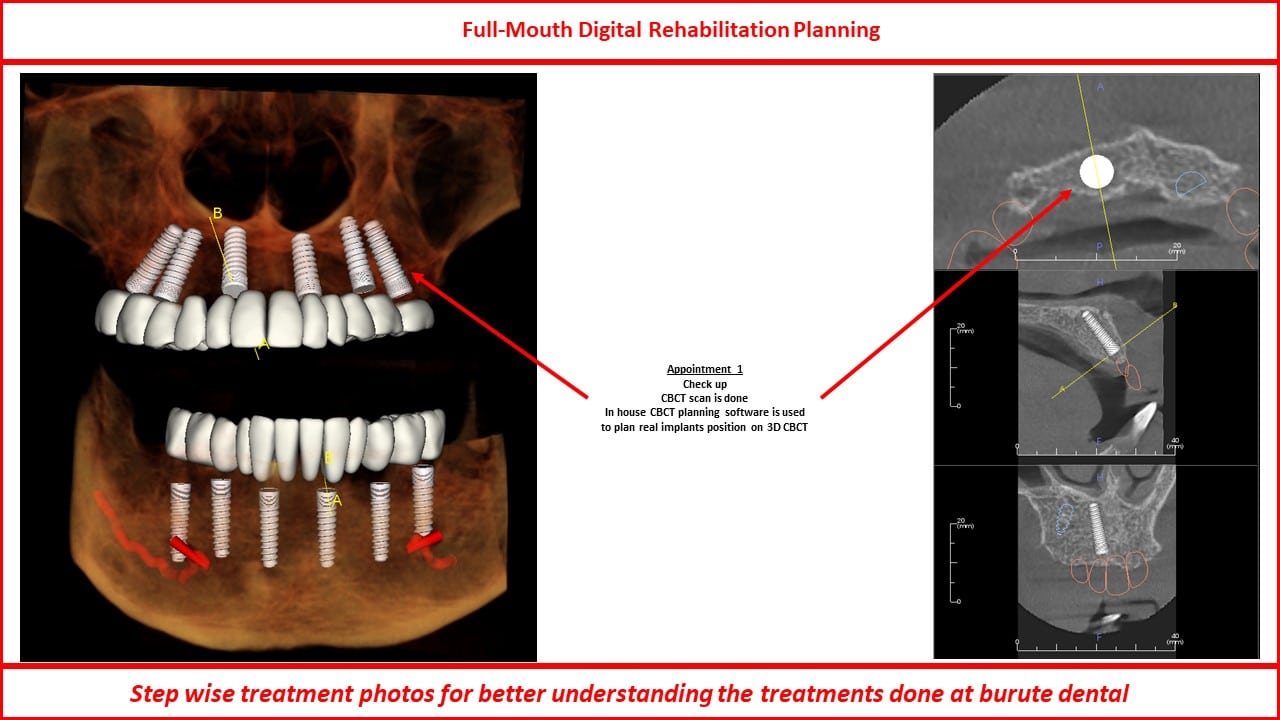
Full-Mouth Digital Rehabilitation Planning

Hundreds of dental clinics offer implant treatment. However, only a limited number of implant specialists have dedicated implant-planning software and perform their own CBCT-based planning. Many implant dentists rely on treatment plans prepared by CBCT centres or other clinicians. 

When implant planning is performed by someone other than the treating implant dentist, the surgeon may have to rely on a plan created by another person. This can create a gap between the planned treatment and the clinical realities encountered during surgery. 

CBCT planning is not simply a radiographic exercise. It requires an understanding of implant positioning, available bone, prosthetic requirements, surgical access, anatomical limitations, and the practical challenges that may be encountered during implant placement. 

A clinician who routinely performs implant surgery can incorporate this real-world surgical experience into the planning process. 

Dr. Mrunal Burute performs his own CBCT-based implant planning using dedicated implant-planning software. Each implant is meticulously planned in three dimensions, taking into consideration the available bone, anatomical structures, prosthetic requirements, and surgical considerations. 

The digitally planned implant position is then carefully replicated during surgery using a computer-guided approach, aiming to achieve the highest possible accuracy between the virtual plan and the actual implant position. 

This integrated approach—planning and surgical execution by the same implant specialist—helps minimize discrepancies between the digital treatment plan and the clinical outcome and provides greater control over the entire implant treatment process. 

Slide40
Services 81

Digital planning charges as applicable
Final full-mouth treatment quote after complete design

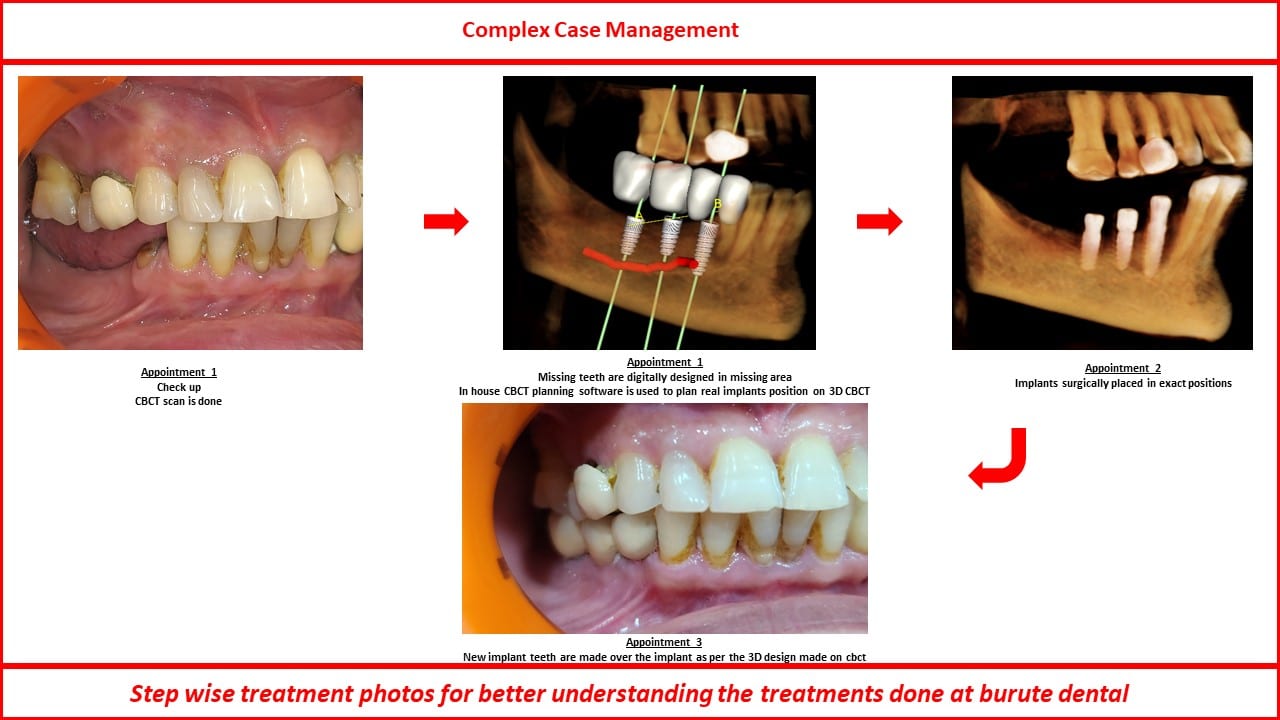
Complex Case Management

The patient presented with multiple factors that made implant placement challenging, including reduced bone width and height, poor bone quality, previously infected teeth now extracted, poor oral hygiene, vitamin B12 and vitamin D3 deficiencies, diabetes, and an increased susceptibility to infection. 

The major challenges were: 

– Adequate bone width and height were required for predictable implant placement. 

– The previously infected teeth had to be removed as conservatively as possible to minimize further loss of the surrounding bone. 

– All chronic infection had to be thoroughly eliminated before implant placement. 

– Bone grafting was preferably avoided because of the patient’s diabetic status and increased risk of infection. 

– The treatment also had to be planned within the patient’s budget constraints. 

The implant system was selected based on its use of Grade 23 titanium, which provides high mechanical strength and allows appropriately selected narrow-diameter implants to withstand the functional demands of posterior teeth. 

CBCT-based computer-guided implant planning and placement were used to achieve precise three-dimensional positioning of the implants while making optimal use of the available bone. 

Following implant placement and osseointegration, a PEEK prosthesis was fabricated to help reduce occlusal forces and improve the biomechanical distribution of load across the implants. The objective was to minimize excessive stress on the implants and surrounding bone and thereby reduce the risk of marginal bone loss. 

This approach allowed the treatment to be completed with minimal bone augmentation, precise implant positioning, and a prosthetic design aimed at reducing functional loading, while also taking the patient’s systemic condition and financial limitations into consideration. 

Slide41
Services 82

Customized treatment planning and procedure package
Final quote after complete evaluation.